
In the confectionery world, color is the primary driver of the sensory experience. Blue, historically associated with “Blue Raspberry” or “Cool Mint” flavors, is one of the most sought-after hues in kid-friendly snacks and premium sweets. However, as the global “Clean Label” movement accelerates, the reliance on synthetic Brilliant Blue FCF (Blue 1) is declining. For candy manufacturers, the transition to natural blue has been a technical gauntlet—until the mainstream adoption of Gardenia Blue. Unlike other botanical pigments, Gardenia Blue provides the vividness and stability required to survive the aggressive processing conditions of sugar-based matrices.
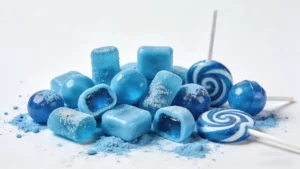
Hard-boiled candies represent the ultimate challenge for natural pigments. The process involves boiling sugar and glucose syrups to temperatures between 140°C and 150°C to achieve a “hard crack” stage with less than 2% residual moisture.
Thermal Resilience: Most protein-based pigments, such as Spirulina, begin to denature and turn grey or brown at 60°C. Gardenia Blue, however, maintains its molecular integrity even at peak boiling temperatures.
The “Late-Addition” Strategy: To maximize color brightness, technical experts recommend adding Gardenia Blue at the end of the vacuum-cooling stage, typically around 110°C. Its rapid solubility ensures an even distribution within the viscous sugar mass without the risk of “hot-spot” fading.
Clarity and Brilliance: In clear hard candies, Gardenia Blue produces a glass-like transparency that is impossible to achieve with suspension-based pigments.
The gummy category (Gelatin, Pectin, or Starch-based) is perhaps the most diverse application for Gardenia Blue.
The pH Dilemma: Most gummies are formulated with high levels of citric, malic, or tartaric acid to achieve a “sour” or “fruity” profile, often bringing the pH down to 3.2 – 3.6. While Butterfly Pea or Anthocyanins would shift to purple or pink in this range, Gardenia Blue stays a true, consistent blue.
Interaction with Gelling Agents: * Gelatin: Gardenia Blue integrates seamlessly with the protein matrix of gelatin, providing a bouncy, vibrant blue hue.
Pectin: In vegan-friendly pectin gummies, the pigment maintains high clarity and does not interfere with the delicate setting time (gelation) of the pectin.
Anti-Migration: A common issue in multi-colored gummy packs is “color bleeding.” Because Gardenia Blue has a high affinity for the sugar-acid matrix, it resists migration, ensuring a blue gummy doesn’t stain its yellow or red neighbor.
The rise of premium, colorful white chocolate and compound coatings has created a demand for fat-dispersible blue pigments.
Emulsification is Key: While Gardenia Blue is naturally water-soluble, it can be successfully utilized in fat-bases (like cocoa butter) through the use of high-quality emulsifiers like Sunflower or Soy Lecithin.
Pastel Shades: When added to a white chocolate base, Gardenia Blue produces high-end pastel shades, such as “Mint Blue” or “Tiffany Blue,” which are highly popular in wedding and gift confectionery.
Stability in Fat: Unlike some fruit-derived pigments that can turn “muddy” when mixed with lipids, Gardenia Blue retains its “cool” blue undertone, providing a clean visual profile.
Panning involves building up hundreds of thin layers of sugar syrup on a center (like a nut or a chocolate bean).
Layering Consistency: Gardenia Blue’s high tinting strength allows for very thin, even layers. Manufacturers can achieve a deep “Navy Blue” shell by increasing the concentration in the final polishing syrup.
Matte vs. Gloss: Whether the final product is a matte-finished compressed tablet or a high-gloss polished candy, Gardenia Blue remains uniform, avoiding the “speckling” or “mottling” common with poorly soluble pigments.
In aerated products, light is scattered by millions of tiny air bubbles, which can “dilute” the visual impact of a color.
Overcoming Air Dilution: Because Gardenia Blue has superior tinting strength, it maintains a visible presence even in high-overrun marshmallows. It provides a soft “Cotton Candy Blue” that stays vibrant even as the product ages on the shelf.
Synergy with Foaming Agents: It does not affect the surface tension of egg albumin or pea protein, ensuring that the fluffiness and volume of the nougat are preserved.
Mint and Menthol: Gardenia Blue is the industry standard for mint-flavored sweets. It complements the “cooling” sensation of menthol perfectly.
Vitamin Fortification: In “Functional Gummies” (Vitamin C, D, or Zinc), Gardenia Blue acts as a stable carrier. While Vitamin C can bleach some natural pigments, the polymerized structure of Gardenia Blue offers a higher degree of resistance to oxidative degradation.
Confectionery products often have shelf lives ranging from 12 to 24 months.
Light Stability: Many candies are sold in transparent pouches. Gardenia Blue outperforms Spirulina significantly in light-fastness tests. While some fading is inevitable over 2 years in direct sunlight, Gardenia Blue remains within the “acceptable” range far longer than other botanical options.
Crystallization Control: It does not promote or inhibit sugar crystallization, ensuring the “mouthfeel” of the candy remains as intended by the developer.
For brands exporting to Asia and Europe, Gardenia Blue (Gardenia Extract) is a well-established and trusted ingredient. It fulfills the “Natural” and “Botanical” claims that modern parents look for in children’s snacks. We provide full documentation—including COA, TDS, and Allergen Statements—to facilitate a smooth transition from synthetic dyes to our high-purity extract.
The transition to natural color in confectionery is no longer a technical compromise; it is an engineering triumph. Gardenia Blue provides the thermal stability for hard candies, the pH resilience for sour gummies, and the aesthetic brilliance for premium chocolates. By adopting this botanical champion, manufacturers can deliver the vivid experiences consumers love while maintaining the “Clean Label” integrity they demand.