
In the competitive landscape of frozen desserts, visual differentiation is key to capturing consumer attention. Blue hues—ranging from “Sea Salt Blue” and “Tiffany Blue” to vibrant “Galaxy” swirls—have become a massive trend in premium ice cream and plant-based gelatos. However, delivering a stable blue in a dairy or fat-heavy matrix is technically demanding. As brands move away from synthetic dyes (Blue 1), Gardenia Blue for Ice Cream has emerged as the gold standard. Utilizing a stable natural blue pigment allows formulators to achieve high visual impact without compromising on clean-label integrity.
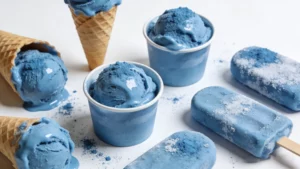
Ice cream is a complex emulsion of air, water, fat, and proteins. Unlike clear beverages, the “base” of ice cream is opaque white, which significantly affects how a natural blue food color performs.
The Opacity Effect: When Gardenia Blue is added to a white dairy base, it naturally produces soft, pastel tones. To achieve a deep “Electric Blue,” a higher color value (E-value) extract is required.
Protein Shielding: Our extract integrates flawlessly with milk proteins (casein and whey). Unlike some botanical options, it remains evenly dispersed, ensuring a smooth, streak-free appearance across every batch.
The production of ice cream mix involves a rigorous pasteurization step (typically 85°C for 15 seconds or 65°C for 30 mins). This stage is the primary failure point for many botanical ingredients.
The Heat Advantage: This is a crucial area where we see the benefit of using a heat stable natural blue for pasteurization. While other pigments begin to degrade and turn grey or brown at 60°C, our stable natural blue pigment is thermally robust. It can withstand the pasteurization cycle with zero color loss, allowing for “Pre-Pasteurization” addition which ensures total microbial safety and uniform color integration.
When choosing a coloring agent, R&D managers often perform a Gardenia Blue vs. Spirulina in dairy comparison. While Spirulina is a popular choice for cold-process foods, its limitations in the frozen dessert industry are significant.
Structural Integrity: In the “Gardenia Blue vs. Spirulina in dairy” debate, Gardenia wins on resilience. Spirulina is protein-linked and often denatures during the aging of the ice cream mix, leading to sedimentation.
Flavor Profile: A major technical breakthrough is providing a natural blue color with no fishy smell. One of the biggest complaints about high-dose Spirulina is its distinct marine odor. Our Gardenia Blue extract is a purified botanical solution with a neutral sensory profile. This natural blue color with no fishy smell allows delicate flavors like Vanilla, Cream, or Sea Salt to remain pure and untainted.
Ice cream is often sold in glass-fronted “scooping” cabinets or transparent tubs, exposing the product to constant LED or fluorescent lighting.
Photo-Stability: Many natural pigments fade rapidly under these conditions. The need for a light-fast blue for frozen desserts is paramount for retail success. Our extract’s polymerized structure offers superior resistance to photo-oxidation. This stable natural blue pigment maintains its vibrant hue throughout the typical 6–12 month shelf life, preventing the “white-top” effect where the surface of the ice cream fades before the interior.
As the market for Oat, Almond, and Coconut-based frozen desserts grows, formulators require a pH stable natural blue for plant-based gelato.
Acidic Base Compatibility: Some plant-based bases have a slightly lower pH than traditional dairy. Using a pH stable natural blue for plant-based gelato ensures that the color does not shift toward purple or pink. Gardenia Blue for Ice Cream does not react with the different protein structures of plant milks, maintaining a consistent color regardless of the botanical source of the base.
Overrun (the amount of air whipped into the ice cream) significantly affects how a natural blue food color is perceived by the eye.
The Air Dilution Factor: High-overrun industrial ice creams (100%+) will appear much lighter than low-overrun artisan gelatos using the same dosage of Gardenia Blue.
Technical Tip: Formulators must adjust the dosage based on the final aeration levels. Because it has a high tinting strength, it remains a cost-effective stable natural blue pigment even when compensating for high air inclusion.
Our natural blue food color is the perfect primary pigment for secondary frozen dessert shades:
Natural Mint Green: Blend our blue extract with Gardenia Yellow. This creates a “Cool Mint” green that is far more stable than chlorophyll in frozen storage.
Natural Lavender/Purple: Blend the blue with Beetroot Red. This provides a stable purple that doesn’t shift toward brown, perfect for taro or blueberry cheesecake flavors.
In multi-colored ice creams (e.g., a blue and white “Cloud” swirl), pigment migration can be an issue.
Matrix Affinity: Our Gardenia Blue for Ice Cream has a high affinity for the sugar-stabilizer matrix. By properly balancing the stabilizers (like Guar Gum or Locust Bean Gum), manufacturers can achieve sharp, distinct blue swirls that do not “bleed” into the white base over time.
Gardenia Blue for Ice Cream represents the pinnacle of natural coloring technology. Its combination of being a heat stable blue pigment for pasteurization, its status as a light-fast blue for frozen desserts, and its natural blue color with no fishy smell makes it the only viable choice for premium brands. By choosing a stable natural blue pigment, ice cream manufacturers can finally replace synthetic dyes with a botanical solution that meets every technical and consumer demand.