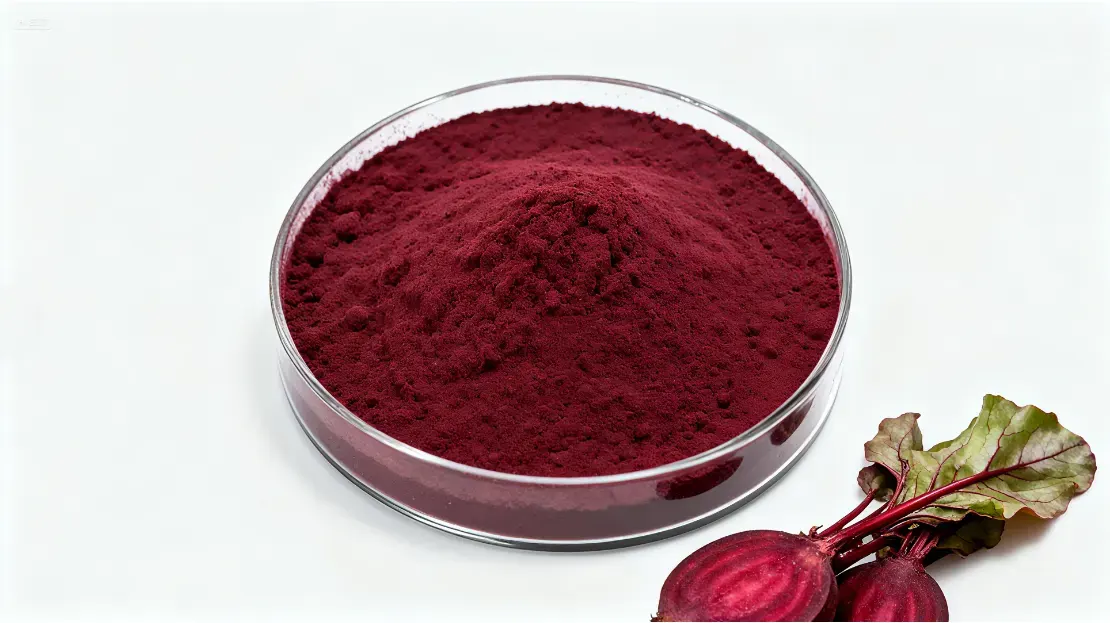
Color value: E50
Appearance: Purplish Red Powder
Certificate: ISO9001/ISO22000/FDA/Kosher/halal/IFS/BRC
Sample: Free Sample Available
Package: 1kg/Bag, 25kg/drum
Beet Red, also known as Beetroot Red or Betanin, is a highly concentrated natural pigment extracted from the roots of the red beet (Beta vulgaris). As the global food industry in 2026 shifts away from synthetic dyes, this botanical source has solidified its position as the most trusted ingredient for achieving shades ranging from soft pastel pinks to vivid magentas.
The primary coloring compound, Betanin, belongs to the betalain family of pigments. Unlike anthocyanins found in berries, Beet Red offers a distinct advantage: its color remains remarkably stable across a wide pH range (pH 3.0 to 7.0). This versatility allows manufacturers to achieve consistent visual appeal in diverse food matrices without the regulatory challenges of artificial additives.
The quality of our extract is the result of a refined, low-temperature aqueous extraction technology. This process is specifically designed to preserve the delicate betalain structures that give the pigment its intensity. The production begins with the selection of non-GMO, high-sugar beets, which are carefully processed to extract the maximum pigment concentration.
To achieve a premium concentrated powder or liquid, we utilize multi-stage membrane filtration and vacuum evaporation. These steps ensure that the Beet Red is concentrated without being exposed to prolonged high heat, which can cause the color to brown. Our advanced purification also significantly reduces the characteristic “earthy” flavor, resulting in a final product that delivers high tinctorial strength with a neutral sensory profile.
For decades, the industry relied on Carmine (extracted from insects) for stable reds. However, in 2026, the demand for vegan-friendly ingredients has made Beet Red the preferred choice. As a 100% plant-based and allergen-free colorant, it allows brands to maintain a “cruelty-free” image while meeting Kosher and Halal requirements.
One of the greatest strengths of this extract is its stability in the pH range of 4.0 to 7.0. While many natural red colors turn blue or grey in neutral environments, Beet Red maintains its brilliant pinkish-red hue. This makes it the ideal choice for dairy products, plant-based milks, and neutral pH desserts.
Beyond its coloring power, the pigment contains bioactive betalains recognized for their antioxidant properties. Incorporating this solution allows manufacturers to leverage the “health halo” of beetroot. By utilizing this source, you are adding an ingredient that consumers recognize as a functional superfood, adding tangible value to the end product.
Plant-Based Meat Analogues: The extract is a critical ingredient for creating the “bleeding” effect in plant-based burgers. It provides a realistic raw-meat color that transitions naturally during the cooking process.
Dairy & Frozen Desserts: It is the industry standard for strawberry-flavored yogurts and ice creams, where it provides a soft, appetizing pink that consumers love.
Confectionery & Gummies: Used extensively in fruit chews and gummies. In these applications, the pigment provides a stable, bleed-resistant color that remains vibrant throughout the shelf life.
Dry Mixes & Instant Beverages: Due to its excellent solubility, the powder is perfect for protein powders, instant fruit lattes, and vitamin-enhanced drink mixes.
Nutraceuticals: Beet Red is often applied as a natural film-coating for tablets and used in functional powders to signal health and purity.
Temperature Management: This pigment is sensitive to prolonged high heat. It is best suited for products with short heating cycles or those that are cold-processed.
Light and Oxygen Protection: Like most botanical colors, the shade can degrade when exposed to light. We recommend using UV-protected packaging and adding antioxidants like Vitamin C to extend the color’s lifespan.
Water Activity Considerations: The extract is most stable in products with low water activity ($a_w$). In high-moisture environments, keeping the product refrigerated can help maintain the vibrant red shade for longer periods.
Our production is sourced from sustainable farms that prioritize soil health and water conservation. In 2026, our Beet Red is fully compliant with global safety standards:
USA: FDA approved as a color additive exempt from certification.
Europe: Classified as a food ingredient with coloring properties (E162), ideal for E-number-free labeling.
Traceability: We offer “Farm-to-Formula” traceability, ensuring that every batch meets the highest quality and safety standards.
Q1: Can Beet Red achieve a deep “Fire Engine” red?
Yes. By adjusting the dosage, you can achieve intense magenta and red shades. For a more “orange-red,” it can be blended with natural yellows like Curcumin.
Q2: Does the extract affect the flavor of the final product?
Through our advanced purification, we minimize the earthy notes of the raw beet. At standard dosage levels, our solution is virtually tasteless and odorless.
Q3: Is Beet Red stable in acidic beverages?
Absolutely. It is stable down to pH 3.0, making it suitable for a wide variety of fruit-flavored drinks and carbonated beverages.
Q4: Is the product available in different forms?
Yes, we provide the pigment in both highly concentrated liquid forms and spray-dried powders to suit different manufacturing requirements.
| Item | Specification | Method |
| Physical and Chemical Properties | ||
| Color Value | 50 | E1%, 1cm 535nm |
| Appearance | Purplish Red Powder | Visual |
| Smell | Characteristic | Olfactory |
| Impurity | No Visible Impurity | Visual |
| PH | 4-6 | / |
| Ash | ≤ 14g/100g | USP <561> |
| Identification | Conforms with TLC | TLC |
| Carrier | Maltodextrin | TLC |
| Residue Analysis | ||
| Heavy Metals | ≤ 10ppm | ICP-MS |
| Lead (Pb) | ≤ 2.0ppm | ICP-MS |
| Arsenic (As) | ≤ 2.0ppm | ICP-MS |
| Cadmium (Cd) | ≤ 1.0ppm | ICP-MS |
| Mercury (Hg) | ≤ 0.1ppm | ICP-MS |
| Microbiological Tests | ||
| Total Plate Count | ≤ 1,000cfu/g | USP <61> |
| Total Yeast & Mold | ≤ 100cfu/g | USP <61> |
| E. Coli. | Negative/g | USP <62> |
| Salmonella | Negative/25g | USP <62> |
| S. aureus | Negative/g | USP <62> |