
As the food industry transitions away from synthetic dyes like Brilliant Blue FCF, Gardenia Blue has emerged not just as a replacement, but as a high-performance functional ingredient. While its chemical stability is well-documented, the successful application of Gardenia Blue in complex food matrices requires a deep understanding of its interaction with other ingredients. This guide explores the technical nuances of applying Gardenia Blue across various sectors, ensuring vibrant, consistent, and shelf-stable results.
Gardenia Blue is a water-soluble pigment, typically available in powder or liquid form. For industrial applications, proper dissolution is the first step to ensuring color uniformity.
Pre-blending: To avoid “specking” or uneven dispersion, it is recommended to pre-dissolve Gardenia Blue powder in deionized or filtered water at a ratio of 1:10.
Temperature of Dissolution: While it dissolves in cold water, using warm water (approx. 40°C–50°C) accelerates the process without risking degradation, as the pigment is thermally robust.
Ion Sensitivity: Gardenia Blue is relatively stable in the presence of calcium and magnesium ions; however, in extremely hard water, a slight shift in clarity may occur. Using chelated water or soft water yields the most transparent blue hues.
The beverage sector is the largest market for Gardenia Blue, but it also presents the most challenges regarding pH and clarity.
Carbonated Soft Drinks (CSDs) & Functional Waters: In clear beverages, Gardenia Blue provides a brilliant, transparent sky-blue color. Unlike Spirulina, it does not cloud the liquid.
Acidic Environments: One of the greatest advantages of Gardenia Blue is its performance in low-pH environments (pH 3.0–4.5). While anthocyanin-based blues shift to purple in these ranges, Gardenia Blue remains a steady blue.
Dosage Guidelines: For a light “Aqua” tint, a dosage of 0.01% – 0.05% is usually sufficient. For a deep “Midnight Blue,” concentrations may increase to 0.1% – 0.2%.
Alcoholic Beverages: Gardenia Blue is soluble in ethanol-water mixtures (up to 50% alcohol content), making it ideal for liqueurs and craft cocktails where Butterfly Pea might be too sensitive to fruit mixers.
Confectionery manufacturing often involves temperatures exceeding 140°C, which would destroy most botanical pigments.
Hard-Boiled Candies: Gardenia Blue can be added directly to the sugar mass at the cooling stage (around 110°C–120°C). Its high thermal stability ensures that the blue remains vibrant even after the high-heat cooking process.
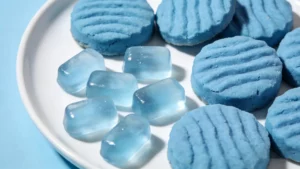
Gummies and Jellies: In gelatin or pectin-based gummies, Gardenia Blue provides a clean, transparent look. Because many gummies are acidic (containing citric or malic acid), Gardenia Blue’s pH stability prevents the “accidental purple” shift common with other natural dyes.
Chewing Gum: Its resistance to mechanical shear during the extrusion of gum base makes it superior to Spirulina, which can lose intensity under heavy mixing.
Dairy products provide a white, opaque background that changes the visual perception of the blue pigment.
Ice Cream & Frozen Desserts: When added to a white cream base, Gardenia Blue produces a soft “Baby Blue” or “Tiffany Blue.” Because it is light-stable, the color won’t fade during storage in glass-fronted supermarket freezers.
Yogurt & Fermented Milks: Gardenia Blue is stable against the metabolic activity of lactic acid bacteria. It can be added before or after fermentation without affecting the microbial culture or the final color.
Plant Milks (Oat, Almond, Soy): The proteins in plant milks can sometimes interact with natural colors. Gardenia Blue’s non-protein structure reduces the risk of protein-pigment precipitation, maintaining a smooth, chalk-free appearance.
Bakery is often the “graveyard” for natural colors due to the Maillard reaction and high internal temperatures.
Fillings and Frostings: Gardenia Blue is exceptionally stable in cream fillings and fat-based frostings. While it is water-soluble, it can be dispersed in fat-rich matrices using an emulsifier (like lecithin).
Extruded Snacks: In cereal or snack production, the pigment survives the extrusion process, providing a consistent external or internal color that doesn’t turn “muddy” brown under heat.
Dosage Note: Due to the opacity of flour and starch, higher dosages (0.15% – 0.3%) are often required compared to clear beverages.
The Ultimate Natural Green: Mixing Gardenia Blue + Gardenia Yellow (or Curcumin) creates a range of greens that are heat-stable and light-stable. This is the industry standard for lime-flavored beverages and green apple confectionery.
Deep Purples: Pairing Gardenia Blue + Beetroot Red (or Anthocyanins) results in a violet/purple that is significantly more stable than single-source grape skin extracts, especially in processed snacks.
Sedimentation: If sediment occurs in beverages, it is often due to an interaction with high-calcium minerals or certain botanical extracts. Solution: Use a sequestering agent or adjust the filtration process.
Color Over-intensity: Gardenia Blue has a high “Tinting Strength.” Small variations in dosage can lead to large visual changes. Precision weighing is critical.
Interaction with Vitamin C: High doses of Ascorbic Acid can sometimes cause fading in natural pigments over long periods. In fortified drinks, it is recommended to conduct a 6-month accelerated shelf-life test.
Gardenia Blue (often listed as Gardenia Extract) is widely approved in major markets including China, Japan, and Korea. In the EU and North America, it is gaining traction as a “Coloring Foodstuff” or through specific GRAS (Generally Recognized as Safe) notifications. Manufacturers should verify local labeling requirements (e.g., “Gardenia Blue” vs. “Gardenia Extract for color”).
The transition to natural color is no longer a technical compromise. By leveraging the specific application protocols of Gardenia Blue, food scientists can achieve the vivid, reliable, and stable blue hues that consumers demand. Its versatility from pH 3.0 to high-heat bakery applications makes it the cornerstone of the modern clean-label color palette.
Explore the Technical Possibilities Whether you are formulating a new functional beverage or a high-heat snack, our technical team provides the expertise and high-purity Gardenia Blue extracts you need.