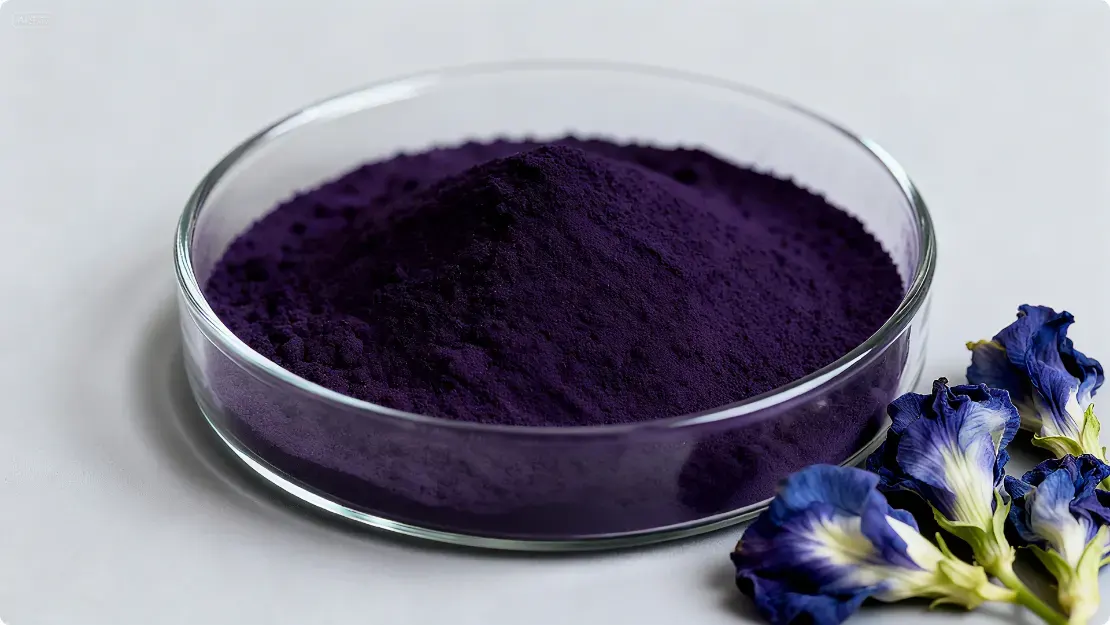
Butterfly pea blue is an anthocyanin colour extracted from the dried flowers of Clitoria ternatea. In the United States it holds its own listing as a colour additive under 21 CFR 73.69, and of the three commercial botanical blues it carries the broadest permitted list of uses. What surprises most buyers is the specification: the extract itself is defined at an acidic pH, not a neutral one.
What the US specification requires
- pH, not less than 3.0 and not more than 4.5 at 25 °C. This is a specification on the extract as supplied, so a sample arriving at neutral pH does not conform even if it looks the right colour.
- Heavy metals: lead, arsenic, mercury and cadmium each not more than 1 ppm — a tighter set of limits than several other colourants in the same part.
- Identity route. The listing describes an aqueous extraction followed by ultrafiltration, concentration and pasteurisation, with citric acid permitted for pH control. That is worth stating in writing, because it separates a compliant extract from a simple flower powder.
- Form. The listed form is a dark blue liquid; spray-dried powders are supplied in practice and should be specified on their own colour value.
Where the US listing applies
The list is long: alcoholic beverages, sport and energy drinks, flavoured and carbonated water, fruit drinks including smoothies and grain drinks, carbonated soft drinks, fruit and vegetable juice, nutritional beverages, chewing gum, teas, coated nuts, liquid coffee creamers, ice cream and frozen dairy desserts, hard candy, dairy and non-dairy drinks, fruit preparations in yogurts, soft candy, ready-to-eat cereals, crackers, snack mixes, hard pretzels, plain potato chips, and plain corn, tortilla and multigrain chips. It may not be used to colour foods covered by a standard of identity unless that standard authorises the use.
Regulatory status by market
Butterfly pea is the product on this site with the widest gap between what buyers assume and what the regulations actually say. It is listed in the United States and traded as a traditional food across Southeast Asia, but it has no authorisation in the European Union or the United Kingdom, and no additive listing in Korea. Only the markets where it can lawfully be used are set out below.
United States — 21 CFR 73.69
Position
Listed colour additive, exempt from certification, at 21 CFR 73.69, added on 2 September 2021 and extended to further uses on 12 May 2025. The listing defines the article precisely: the water extract of dried butterfly pea flowers, ultrafiltered to remove solids, concentrated, pasteurised, and acidified with citric acid to pH 3.0 to 4.5, with anthocyanins as the principal colouring component.
Permitted use
Colour in the food categories named in the listing, at the specification set there, including limits of 1 mg/kg for lead, arsenic, mercury and cadmium.
Limits
The listing describes one process. An extract made by solvent extraction, or one outside the pH and purity specification, is not the listed additive. This is a listed colour additive exempt from certification, not an FDA approval of the ingredient in general.
Japan — general food ingredient
Position
Butterfly pea is used in Japan as a food ingredient and general food material, with the flower tea itself a long-standing food. It is neither an existing food additive nor a designated additive.
Permitted use
As a food material in foods where a botanical ingredient is acceptable.
Limits
It cannot be declared as a food additive in Japan. A customer who needs an additive declaration for a colour application cannot use this route.
Thailand, Vietnam, Indonesia and Malaysia — traditional food use
Position
Butterfly pea is a traditional beverage and food material across these markets, so it is treated as a food rather than a novel ingredient.
Permitted use
Traditional food and beverage use, including as a colouring ingredient in drinks and desserts.
Limits
Halal certification is a separate gate; since 18 October 2026 Indonesia requires it for additives and raw materials before clearance, with the certificate issued through BPJPH.
The behaviour that decides the application
Anthocyanins respond to pH, so the finished shade depends on the matrix and not only on the dosage: the same lot reads blue close to neutral and drifts toward violet and red as acidity rises. That is why a butterfly pea brief is normally written as a target shade plus the pH it has to be hit at. In the European Union, changing the colour route does not change the status. Clitoria ternatea flowers were notified as a traditional food from a third country, EFSA raised safety objections on cyclotides in 2022, and the Commission closed that procedure in February 2026 without adding the ingredient to the Union list of novel foods; an earlier application for the extract had already been terminated in 2019. Until an authorisation is granted, butterfly pea preparations cannot be placed on the EU market as food, whether they are positioned as an anthocyanin colour or as a colouring food. We supply the material for the markets where it is established, and we say so plainly in a quotation.
How it stacks up against the other two blues on heat, acid and permitted uses is set out in how the three natural blues differ.
Butterfly Pea Blue: The Heat-Stable Natural Solution for Vibrant Azure
Product Overview & Botanical Source
Butterfly Pea Blue, derived from the vibrant petals of Clitoria ternatea, is a revolutionary natural pigment that has redefined the boundaries of botanical colorants. While the industry has long relied on Spirulina for blue shades, Butterfly Pea Blue provides a critical alternative for manufacturers requiring high thermal stability and unique chemical versatility.
In 2026, as the “Clean Label” mandate becomes the global standard, this extract stands out for its high concentration of delphinidin-based anthocyanins. Unlike many other plant colors that fade under stress, Butterfly Pea Blue offers a deep, royal blue hue in neutral environments. It is increasingly favored by R&D managers looking to replace synthetic dyes like Brilliant Blue No. 1 in applications where heat, light, and acidity are determining factors for product shelf-life.
The Science of the “Chameleon” Effect: pH Sensitivity
At Neutral pH (6.0 – 8.0): The extract displays a brilliant, stable “Sky Blue” or “Royal Blue.” This is the primary state used in dairy products and alkaline water.
At Slightly Acidic pH (4.0 – 5.5): As the pH drops, the molecule rearranges into a vibrant violet or purple. This is highly popular in the craft beverage and spirits industry.
At Highly Acidic pH (below 3.5): The color transitions into a bright magenta or fuchsia pink.
Advanced Aqueous Extraction Technology
The quality of our Butterfly Pea Blue is ensured through a proprietary aqueous extraction process. We harvest the flowers at their peak pigmentation and utilize a solvent-free, chilled water system to pull the delicate anthocyanins from the petals.
By avoiding harsh chemicals and excessive heat during the early stages of production, we preserve the bioactive polyphenols that give Butterfly Pea Blue its antioxidant properties. The liquid is then concentrated through multi-stage membrane filtration and finished via advanced spray drying. The result is a fine, 100% water-soluble powder with high tinctorial strength and a neutral flavor profile that does not interfere with the aroma of the final food or beverage product.
Key Technical Advantages
A. Exceptional Thermal Stability
Unlike Spirulina Extract, which denatures at temperatures above 45°C, Butterfly Pea Blue is remarkably heat-stable. It can withstand pasteurization, UHT (Ultra-High Temperature) processing, and hot-fill applications without significant color loss or precipitation. This makes it the go-to natural blue for baked goods, hard candies, and shelf-stable beverages.
B. Photostability & Shelf-Life
Natural blue pigments are notoriously sensitive to light. However, the complex molecular structure of Butterfly Pea Blue provides enhanced resistance to UV degradation. When formulated correctly, it maintains its intensity even in transparent glass or plastic packaging, ensuring the product looks as fresh on the supermarket shelf as it did on the production line.
C. Regulatory Compliance
USA: Butterfly pea flower extract is a listed color additive, exempt from certification, at 21 CFR 73.69. The listing covers the water-extracted, ultrafiltered preparation, so the process route has to match for it to apply.
Europe: Not authorized. The Union novel-food procedure for this material closed without a Union-list entry, so it cannot be placed on the market there as a food ingredient.
Primary Applications in Modern Manufacturing
Craft Beverages & Mixology: Butterfly Pea Blue is the “secret ingredient” in blue gins and color-changing cocktails. It is also perfect for functional teas, energy drinks, and flavored syrups.
Confectionery & Bakery: Due to its heat resistance, it is ideal for macarons, frostings, gummies, and hard-boiled candies. It provides a stable blue that survives the high-heat oven environment.
Dairy & Plant-Based Milks: In pH-neutral environments like soy milk or Greek yogurt, Butterfly Pea Blue delivers a soft, appealing pastel blue that complements clean-label branding.
Nutraceuticals: The extract is often used in antioxidant-rich “superfood” powders, vitamin-enhanced waters, and natural tablet coatings.
Personal Care: Its vibrant hue and skin-soothing properties make it a popular choice for “ocean-themed” facial masks, serums, and bath salts.
Stability Optimization Guide
Buffer Management: If you desire a consistent blue in a slightly acidic beverage, consider using buffering agents (like sodium citrate) to stabilize the pH around 6.0.
Water Quality: High mineral content in hard water can occasionally shift the shade. We recommend using deionized or purified water for the most vibrant results.
Antioxidant Synergy: Combining Butterfly Pea Blue with other natural antioxidants like Vitamin C can further extend the shelf-life of the color in liquid applications.
FAQ
Q1: How does Butterfly Pea Blue compare to Blue Spirulina? While both are natural blues, Butterfly Pea Blue is heat-stable and pH-sensitive, shifting from blue to purple. Blue Spirulina is a more “electric” blue but is sensitive to heat and acid. Many manufacturers use Butterfly Pea Blue specifically for baked or shelf-stable goods.
Q2: Is the extract standardized for color intensity? Yes. We provide various grades of Butterfly Pea Blue standardized to specific E-values (Color Units). This ensures batch-to-batch consistency for large-scale industrial manufacturing.
Q3: Does it have a strong flavor? Our advanced purification process removes the “earthy” notes typical of dried flowers. The final Butterfly Pea Blue powder has a very low sensory impact, allowing your product’s primary flavors to shine.
Q4: Is it water-soluble? Absolutely. It is 100% water-soluble and produces a crystal-clear solution, making it perfect for high-transparency beverages.
Technical Data Sheet