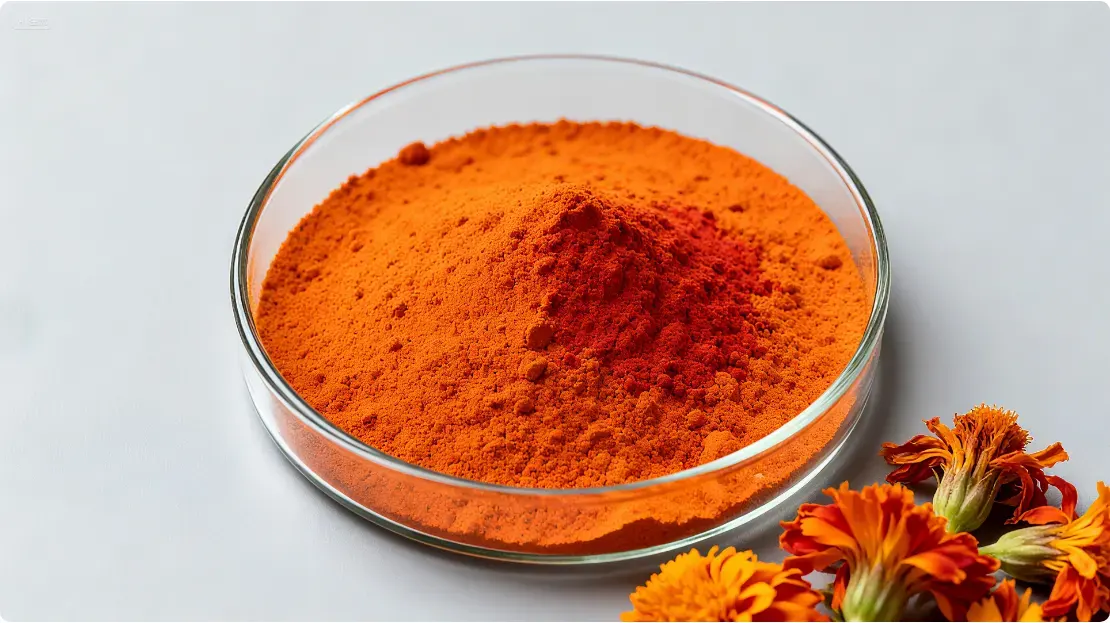
Lycopene is sold at several strengths — 5%, 6%, 10% and higher — and the strength figure is only half of what decides behaviour in a formula. The other half is the delivery route, because lycopene does not dissolve in water, oxidises readily and needs to be dispersed before it can colour anything evenly. A 10% powder is a formulated article rather than a purified crystal, and two suppliers quoting 10% may be selling quite different dispersibility.
We supply lycopene standardised to 10% by HPLC as a dark red powder passing 80 mesh, with loss on drying under 8% and ash under 5%. It is a colour and an active at the same time, which is why the specification below reports both the assay and the full heavy metal and microbiological panel rather than only the number on the front of the spec sheet.
Product Specifications
| Item | Specification |
|---|---|
| Product Name | Lycopene |
| Assay | 10.00% min, HPLC |
| Appearance and Colour | Dark red powder |
| Odour and Taste | Characteristic |
| Particle Size | 100% pass through 80 mesh |
| Loss on Drying | 8.0% max |
| Ash | 5.0% max |
| Total Heavy Metals | 10 ppm max, ICP-MS / AAS |
| Lead | 2.0 ppm max |
| Arsenic | 1.0 ppm max |
| Cadmium | 1.0 ppm max |
| Mercury | 0.1 ppm max |
| Microbiology | TPC 1,000 cfu/g max; yeasts and moulds 100 cfu/g max; E. coli 30 MPN/100 g max; Salmonella and S. aureus negative |
| Packaging | 25 kg net fibre drum with food-grade inner liner |
| Storage | Cool and dry, do not freeze, away from strong light and heat |
| Shelf Life | 24 months when properly stored |
| MOQ | 25 kg (one drum); samples available |
Ten Percent of What, Carried How
The assay is an HPLC figure against a lycopene standard, and it is the only defensible way to state strength — a spectrophotometric reading can be inflated by other carotenoids absorbing in the same region. What the assay does not tell you is how the remaining ninety percent is put together, and that is what governs whether the powder disperses in your process or floats on top of it.
Because lycopene is fat soluble, a water-dispersible powder needs the colour carried in an emulsion or on a carrier that releases it in the right phase. In an oil-based fill, a straight oil suspension may serve better than a powder at all. Ask what the carrier is and match it to the phase you are dosing into; a 10% powder chosen only on price frequently turns out to be the wrong 10% for the application.
Oxidation, Isomerisation and Shelf Life
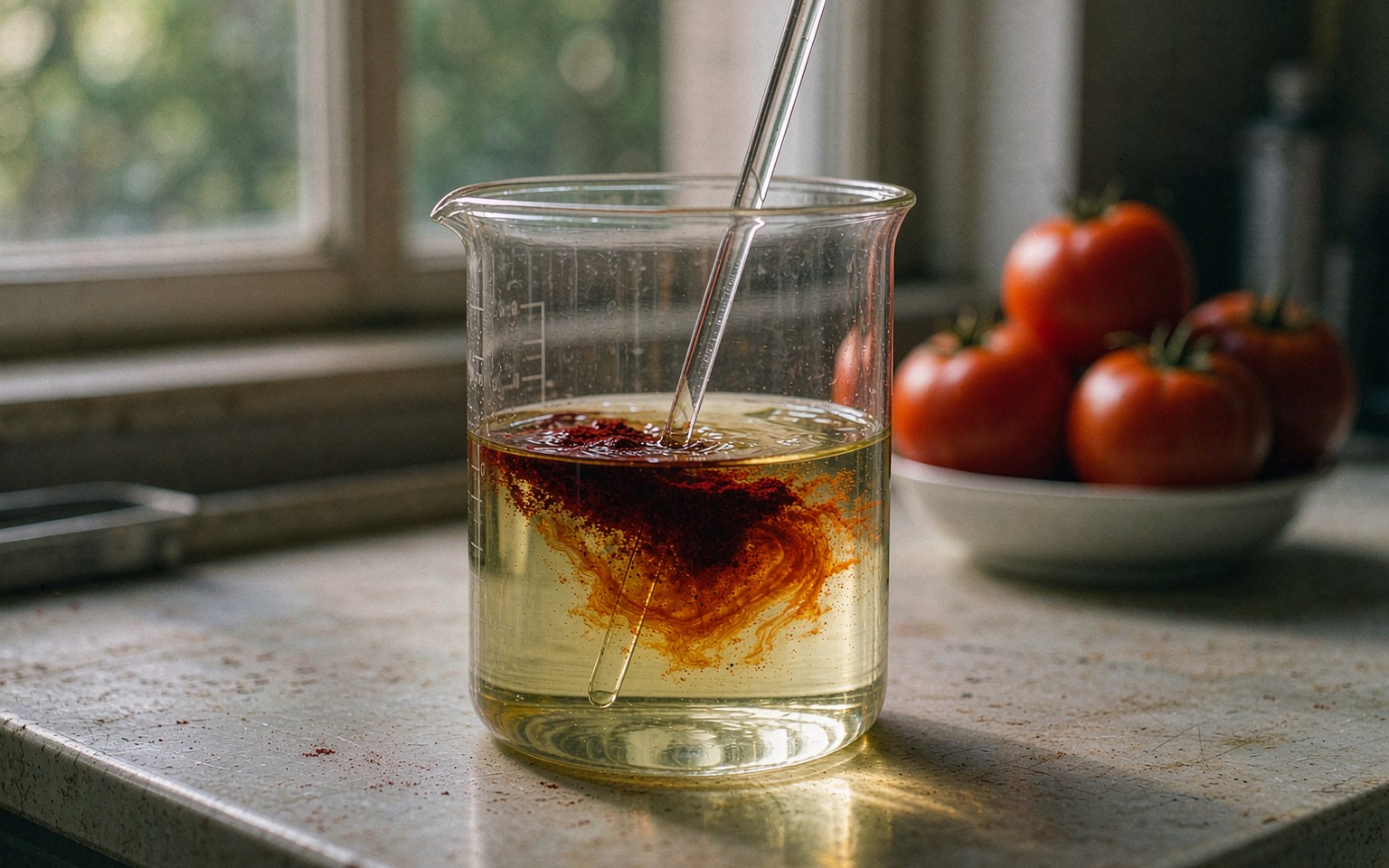
Lycopene oxidises, and oxidation shows first as a dulling of the red rather than as an analytical failure. Light and heat both accelerate it, which is why the storage instruction on the certificate says cool, dry, no freezing and away from strong light and heat — freezing is called out because a frozen drum can take up moisture on thawing and cake. In a finished product, the antioxidants already in the formula are usually doing the protecting; the powder’s job is to arrive with its oxidative load still low.
Heat also drives isomerisation, and the cis and all-trans forms behave differently in a lipid phase. A process step that reaches high temperature for a short time is generally kinder than a long warm hold. If your application goes through a bake or a retort, run a colour retention check at the real process conditions rather than extrapolating from ambient stability.
Applications
- Softgel and oil-suspension capsules, where the colour is carried in the lipid phase
- Tablet and powder blends, dosed for colour or as a carotenoid active
- Beverage and dairy systems that need a tomato-red without a tomato flavour
- Confectionery and dessert coatings where a heat-stable red is required
Why Buyers Source Lycopene From Green Spring
- The assay is stated by HPLC rather than by spectrophotometry, so the 10% figure is specific to lycopene
- Heavy metals by ICP-MS or AAS with each element listed separately, including cadmium at 1.0 ppm
- We also manufacture tomato powder, so a buyer needing both the colour and the vegetable base can source them together
- 25 kg drums on a 24-month shelf life, with samples released against your target assay

Frequently Asked Questions
Is 10% lycopene the same across suppliers?
The assay figure is comparable, but the carrier and the dispersion behaviour are not. Two 10% powders can differ in how they wet out, in which phase they release colour and in how they perform through a heat step. Ask for the carrier and run a dispersion trial on your own process before switching sources.
Can you supply 5% or a higher strength?
Yes, other strengths are quotable on request. Which strength makes sense depends on the dose and on how evenly the powder can be distributed in your mix — a lower strength is easier to blend uniformly in a small dose, a higher strength reduces carrier load in the formula.
Does it need to be refrigerated?
No, and the specification explicitly says do not freeze. Cool, dry, away from strong light and heat is the requirement. Freezing risks moisture uptake and caking on thawing, which is a handling problem rather than an assay problem.
What is the regulatory position?
In the United States, the colour additive listing at 21 CFR 73.585 covers tomato lycopene extract and tomato lycopene concentrate specifically, so whether a given lot falls inside that listing depends on its source and we confirm the source route per order. In the EU, lycopene is authorised as E160d with permitted uses and levels set by food category. Confirm the route for your market before finalising the specification.
Tell us the dose form and the phase you are dosing into, and we will match the grade and quote with a sample. Request a quotation and a sample.