What Makes Turmeric Oleoresin — and Why Two Batches Can Differ
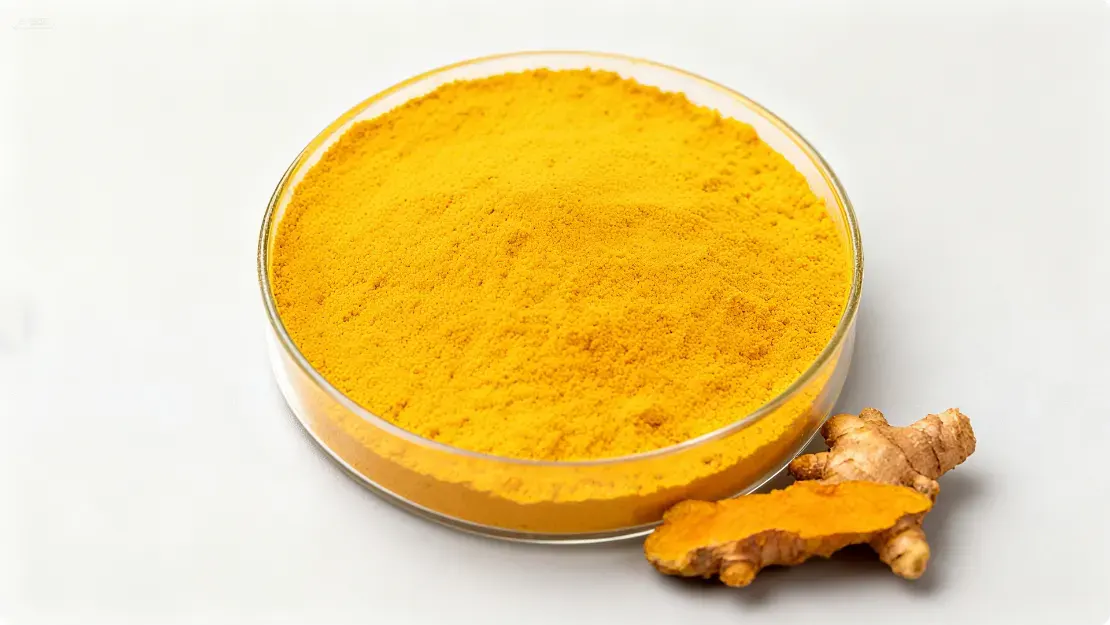
Turmeric oleoresin is not a single molecule. The colour comes from a family of three curcuminoids extracted together from the rhizome of Curcuma longa: curcumin, demethoxycurcumin and bisdemethoxycurcumin. They are close chemical relatives, and each absorbs light at a slightly different wavelength. That is why two materials both sold as “curcuminoid 95%” can arrive as a cooler lemon yellow and a warmer, deeper orange.
Curcumin, the most abundant of the three, reads orange-yellow. Bisdemethoxycurcumin, the least abundant, reads lighter and more lemon. Demethoxycurcumin sits between them. A specification that fixes only the total curcuminoid content tells you how strong the colour is but not what shade it is — and shade is usually the thing the brand team already approved.
So it is worth writing the curcuminoid profile into the specification, not just the total. It is a short conversation at enquiry and it removes a colour-matching round from the project later.
Reading a Turmeric Oleoresin Specification
Two numbers on a turmeric oleoresin sheet get confused more often than any others, and they are not related. The colour value — written as E50, E165 or similar — measures how much colouring strength a unit of the material carries. It is an analytical figure about the product. An E number such as E100 is a European regulatory identifier for a permitted colour additive. A specification quoting “E165” is stating a colour value; a specification quoting “E100” is stating a legal category. Reading one as the other is how a label ends up wrong.
Beyond the colour value, these are the entries that decide whether a grade suits your process:
| Specification entry | Why it decides something |
|---|---|
| Curcuminoid profile (curcumin : demethoxycurcumin : bisdemethoxycurcumin) | Sets the shade — crisp lemon yellow at one end of the range, warm orange at the other |
| Total curcuminoids, % | Sets the colouring strength and therefore the use level |
| Oil-soluble or water-dispersible | Decides whether the grade can go into a clear beverage at all |
| Carrier used in the water-dispersible grade | Appears on the ingredient declaration, so it is a labelling decision as well as a technical one |
| Residual solvents | Extraction solvents are regulated, and the limit is set by the applicable food additive rule |
| Heavy metals and microbiology | Reported per batch on the COA |
| Colour value retained on storage | Curcuminoids are light-sensitive; the starting figure and the packaging both matter |
Replacing a Synthetic Yellow: What the Conversion Involves
Turmeric oleoresin is the most common natural stand-in for tartrazine (FD&C Yellow No. 5) in beverages, confectionery and seasonings, and the switch is almost never a straight swap on weight.
- Strength is not equivalent. Match on colour value and on the shade in your own matrix rather than on the quantity the old formula used. A trial in the finished product is the only figure worth dosing from.
- The shade is warmer. Tartrazine is a clean, cool lemon. Turmeric leans warm, so where a cool yellow is essential it is normally blended with a small amount of a blue to pull it back — our notes on spirulina extract and butterfly pea flower extract cover how those two behave in that role.
- Light sensitivity has to be designed around. Curcuminoids fade under UV. Opaque or UV-protected packaging, and where possible a shorter shelf life claim, are the usual answers.
- Flavour is a non-issue at purified grades. The volatile oils that make turmeric taste like turmeric are removed during extraction, which is why a well-made grade colours a vanilla or lemon product without carrying a curry note into it.
At the warm end of the palette, turmeric oleoresin is often used alongside paprika oleoresin, which delivers a deeper red-orange. Blending the two is how a formulator reaches shades that neither ingredient produces alone, and the natural colours range is organised around that kind of combination work.
Which Regulatory Route Applies — Colour Additive or Colouring Food
In Europe this is the question that decides how the ingredient appears on the label, and it is answered by how the material is made and positioned rather than by the shade it produces.
Where a turmeric preparation is placed on the market as a colour additive, it carries the identifier E100 and has to meet the additive specification for curcumin. Where a preparation is instead positioned as a colouring food, it is treated as a food ingredient used for its colouring properties and carries no E number at all. These are alternative routes: a single product does not belong to both, and a description that claims both at once cannot be right.
In the United States the same material is a colour additive exempt from certification, and which listing applies depends on the form. Grinding the rhizome and extracting it with a solvent are two separate listings with two separate section numbers. A supplier should be able to say which one the material actually falls under — quoting the section that describes the ground rhizome for a standardised extract is a common and entirely avoidable error.
Practically, that means one question at enquiry: does the label need an E number, or does it need to carry none? If it needs one, ask for the additive route and the documentation behind it. If it must carry none, ask for the colouring-food route. Settling this before artwork is signed off is cheaper than settling it after.
Regulatory status by market
Turmeric is one of the few colours with a settled position in all six markets, but “turmeric” covers two different regulated articles: the oleoresin, which is what carries the colour, and the ground root, which is a food in its own right. The listing, the E number and the label declaration all follow the form you buy.
United States — 21 CFR 73.615 and 73.600
European Union — E100
United Kingdom — E100
Japan — 既存添加物 ウコン色素
Indonesia, Malaysia, Vietnam and Thailand — INS 100
Korea — 커큐민 (INS 100)
Sourcing Turmeric Oleoresin
Three things are worth putting in the first message. The colour value and the curcuminoid profile you need, since those together define the shade and the strength. The matrix it goes into, because water-dispersible and oil-soluble grades are not interchangeable in a clear drink. And the market it is sold in, because that decides which of the regulatory routes above applies to your label.
We standardise to the colour value and profile you specify, supply both oil-soluble and water-dispersible grades, and issue a per-batch COA with the TDS. For background on how turmeric sits alongside the other plant-derived colours, the guide to natural pigments and their plant sources covers the whole palette, and beetroot red shows the same sourcing questions answered for a red.
Frequently Asked Questions
What is the difference between a colour value like E165 and an E number like E100?
They measure different things and are not related. The colour value, written E50 or E165, is an analytical figure describing how much colouring strength a unit of the material carries. An E number such as E100 is a European regulatory identifier for a permitted colour additive. A specification quoting E165 is stating a colour value; one quoting E100 is stating a legal category, and reading one as the other is how a label ends up wrong.
Why do two batches sold as “curcuminoid 95%” look different in shade?
Because the colour comes from three curcuminoids extracted together: curcumin, the most abundant, which reads orange-yellow; demethoxycurcumin, which sits between; and bisdemethoxycurcumin, the least abundant, which reads lighter and more lemon. A specification that fixes only the total curcuminoid content tells you how strong the colour is but not what shade it is. Writing the curcuminoid profile into the specification removes a colour-matching round from the project later.
Does turmeric oleoresin taste of curry?
Not at purified grades. The volatile oils that make turmeric taste like turmeric are removed during extraction, which is why a well-made grade colours a vanilla or lemon product without carrying a curry note into it.
Is turmeric oleoresin E100, or a colouring food?
These are alternative routes, and a single product does not belong to both. Placed on the market as a colour additive, it carries E100 and has to meet the additive specification for curcumin. Positioned as a colouring food, it is treated as a food ingredient used for its colouring properties and carries no E number at all. Settle which one your label needs before artwork is signed off.
Can turmeric oleoresin go into a clear beverage?
Only as the water-dispersible grade. Oil-soluble and water-dispersible grades are not interchangeable in a clear drink, and the carrier used in the water-dispersible grade appears on the ingredient declaration, so it is a labelling decision as well as a technical one.