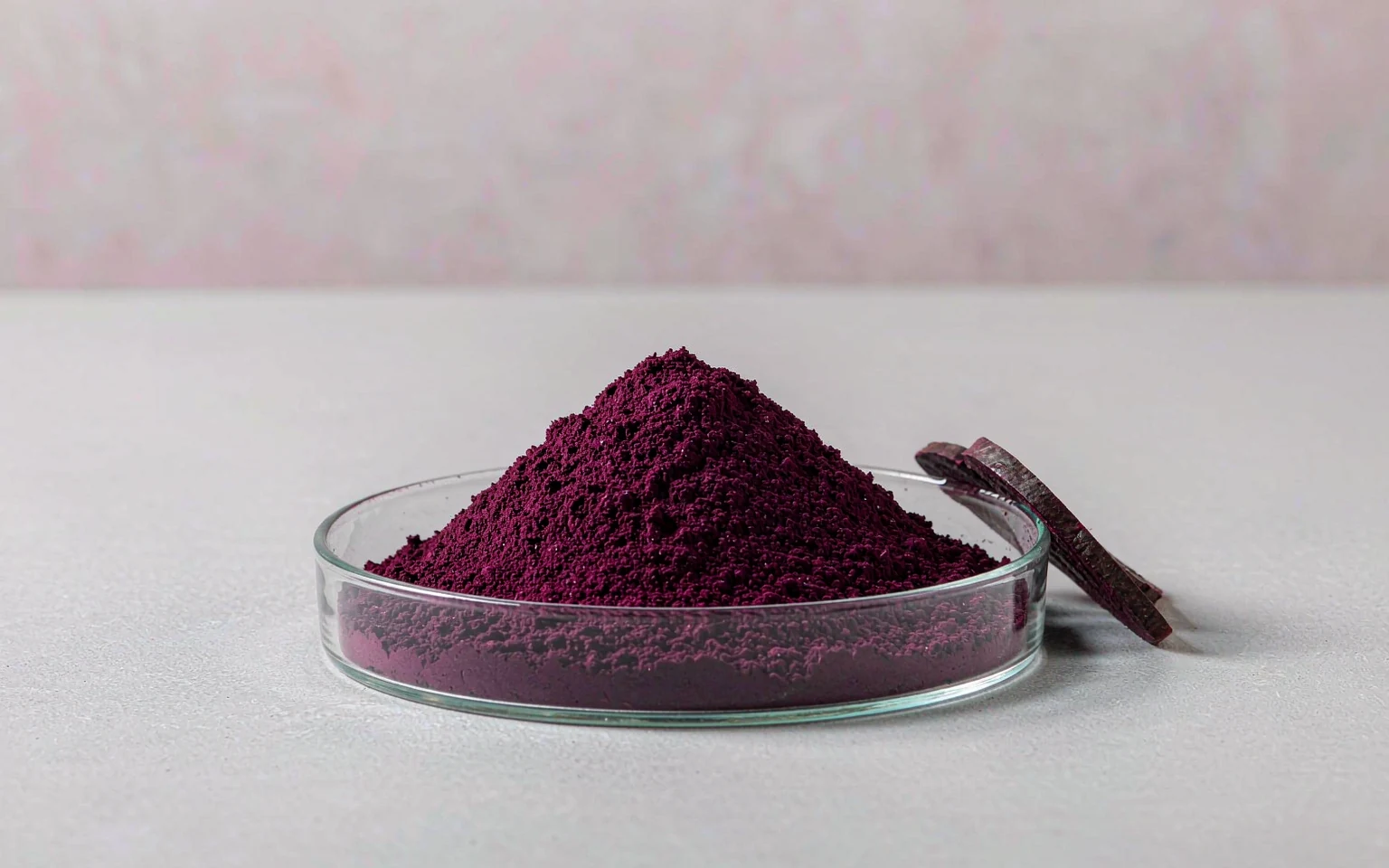
Black carrot concentrate is bought for one reason: it is the most practical natural route to red in an acidic system. It is also the grade most often mis-specified, because the same concentrate reads red in one product and purple in another, and the difference is the formulation rather than the material. This page covers what the concentrate is, how its colour moves with pH, and what to establish before fixing a dose.
Regulatory Identity: Colouring Food, Not Additive
Anthocyanins are the pigment in black carrot and also the substance behind the EU additive entry E 163. The same molecule therefore appears on two different legal footings, and which one a delivery sits on decides how it has to be declared.
The ingredient footing is available where the material is juice that has been concentrated — nothing taken out, nothing added back. Three conditions define it: the carrot must be a food in its own right, the process must be ordinary food processing, and the concentration must stop where that process naturally stops. Push past that line and the material becomes an additive.
For a formulator the practical consequence is simple: decide the target pH and the declaration together, because a concentrate that cannot deliver red at your pH is not a cheaper version of the additive — it is a different product. The US treats the same concentrate as a colour additive from vegetable juice; status has to be confirmed per destination market before use.
Product Specifications
| Item | Specification |
|---|---|
| Product name | Black Carrot Concentrate |
| Colour value | To be confirmed |
| Appearance | To be confirmed |
| Carrier | To be confirmed |
| Solubility | Water-soluble |
| Standard | To be confirmed |
| Packaging | 1 kg bag for bench work, 25 kg drum for production |
| Shelf life | To be confirmed |
| MOQ | To be confirmed |
Fields marked To be confirmed are pending the supplier certificate of analysis for the grade you require. We do not publish indicative figures for colour value or shelf life, because a number that is not tied to a batch record is worse than no number.
Applications
- Acidic beverages — still and carbonated, where pH sits between 2.8 and 3.8
- Confectionery — gummies, jellies and chews where a red to magenta tone is required
- Acidified dairy drinks — the pH window where anthocyanin still reads red
- Fruit preparations and fillings — systems where the fruit acid carries the colour
pH and Colour Drift: Why One Concentrate Reads Two Ways
Anthocyanins behave like a pH indicator, because that is chemically what they are. The flavylium cation that produces red exists at low pH; as the pH rises, the molecule converts through colourless and then blue-purple forms. The transition is not a gradual tint — it is a shift in the dominant species, and it happens over a narrower range than most formulators expect.
In practice this means a black carrot concentrate dosed into a beverage at pH 3.2 gives a clean red with a slight blue undertone. The same concentrate, at the same dose, in a dairy drink buffered near pH 4.5, reads distinctly purple and noticeably weaker. Nothing about the material changed. The matrix did.
Two consequences follow. First, a dose established in one product cannot be transferred to another with a different pH — the colour has to be re-established in the actual matrix. Second, a supplier quoting a single dose figure without asking about pH has not understood the application.
We recommend a pH gradient trial before any specification is fixed: prepare the base at the intended pH, and at two points either side of it, dose at a fixed rate, and read the colour after the process (including any heat step). The result tells you both the dose and how much pH tolerance the formula actually has. Where the target pH sits in the weak part of the curve and cannot be moved, the usual routes are to accept a bluer tone, blend with a heat-stable red for the warm end, or shift the matrix pH within what the product allows. Which one is viable depends on the product, not on the pigment.
Available Forms
Two forms, two specifications. The liquid carries the full juice solids and is priced against its own colour value; the spray-dried powder is a different material with a different value, and the two cannot be converted into each other by arithmetic. Water activity is the other variable — powder suits dry blends and long ambient storage, liquid suits products where the water is going in anyway.
Why Green Spring
- pH gradient support before you commit. Send us the matrix pH and the process step and we will tell you what the concentrate reads at that pH, rather than quoting a dose that was established in water.
- Both anthocyanin routes from one base. The E 163 additive and the concentrate come from the same raw material, so a comparison between them is made on one supply chain instead of two.
- Process documentation handed over first. The route cannot be confirmed without it, so it reaches your regulatory team before anything is signed.
Frequently Asked Questions
Where does E 163 stop and this concentrate start?
E 163 is the additive entry for anthocyanins; the concentrate is juice, declared as juice. Both are red, both come from the same family of raw material, and they behave differently in a formula because one is standardised and the other is not. Which one you can use depends on the market and on whether the process behind the material supports the ingredient route.
Will it drop out of suspension over shelf life?
Anthocyanins dissolve; they do not settle. When a product shows sediment, the cause is usually a protein or a mineral in the matrix reacting with the pigment, or a pH shift that has taken the colour out of its red form. Both show up in a pH gradient trial, and both are fixable in the formula rather than in the concentrate.
How much light exposure can it take?
Less than most formulators assume. Clear glass or PET under retail lighting is the punishing case, and six months on a bright shelf will show. Amber or opaque packaging buys time; so does a shorter shelf life. Where neither is available, this pigment may not be the right one.
What if my product is not acidic?
Then it will not be red. Somewhere above pH 5 the tone turns purple and then blue-grey, and the intensity drops with it. Raising the dose does not bring the red back — it only makes the purple stronger. A neutral product that needs red needs a different pigment.
If you are working on an acidic application and want to compare the concentrate against the additive route, send us the target pH, the process step and the shade you are aiming for, and we will set out what each option requires. Contact us to start that comparison, or see the full colouring foods range.