Color value: E3, E6,E18, E25,E40
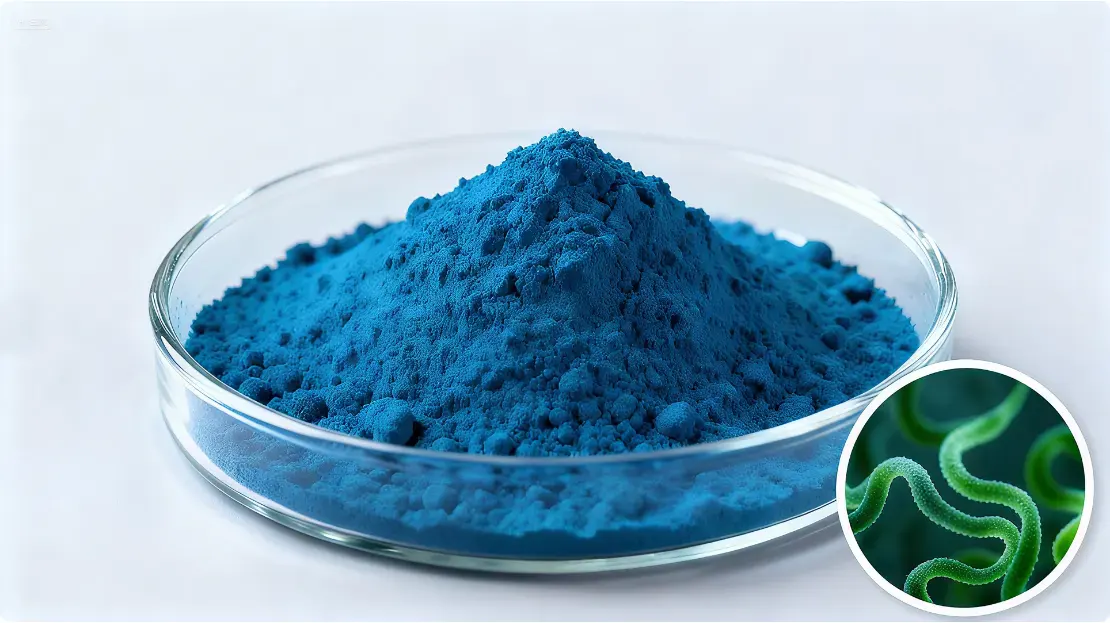
Appearance: Blue Fine Powder
Certificate: ISO9001/ISO22000/FDA/Kosher/halal/IFS/BRC
Sample: Free Sample Available
Package: 1kg/Bag, 25kg/drum
Spirulina Blue, scientifically identified as Phycocyanin, is a premium blue pigment-protein complex derived from non-GMO Arthrospira platensis. As one of the rarest true-blue pigments found in nature, it has become the cornerstone of the global “Clean Label” movement.
In 2026, as global food safety regulations accelerate the phase-out of synthetic dyes like FD&C Blue No. 1, Spirulina Blue has emerged as the industry’s primary natural blue solution. Unlike synthetic alternatives, our extract is processed via gentle water extraction, preserving its delicate protein structure and vibrant azure hue while delivering significant antioxidant properties. It is not just a colorant; it is a functional nutrient that meets both regulatory requirements and the modern consumer’s demand for transparency.
The quality of Spirulina Blue is determined at the moment of extraction. The production process employs a state-of-the-art Chilled Water Extraction method that avoids the use of harsh chemical solvents or high temperatures. This biological approach ensures that the Phycocyanin protein remains in its native, bioactive state throughout the manufacturing cycle.
By utilizing advanced membrane filtration and low-temperature spray drying, we achieve a high concentration of active pigment while eliminating the typical “seaweed” odor. This results in a neutral-tasting, highly concentrated Spirulina Blue powder that integrates seamlessly into delicate flavor profiles—such as vanilla, coconut, or mint—without affecting the sensory experience.
Our Spirulina Blue is engineered for Vibrant Transparency. It produces a crystal-clear blue solution without any grit, sediment, or cloudiness. This high solubility is a critical requirement for high-end functional beverages, flavored waters, and syrups where visual clarity is a primary quality indicator for premium branding.
Beyond its coloring function, this pigment is a potent antioxidant. In the human body, it acts as a free-radical scavenger, supporting immune health and exhibiting anti-inflammatory properties. For manufacturers, this allows for a “Dual-Benefit” marketing strategy: positioning the product as both a natural Spirulina Blue colorant and a “Functional Superfood,” adding tangible value to the end consumer.
Navigating global regulations is a significant challenge for international brands. Our Spirulina Blue is fully compliant with the latest 2026 safety standards:
USA: FDA 21 CFR 73.530 (Spirulina extract as a color additive exempt from certification).
Europe: EU “Coloring Foods” guidelines, where the extract is classified as a food ingredient with coloring properties rather than a synthetic additive (E-number free).
Global Markets: Our production facility is certified Non-GMO, Halal, and Kosher to ensure a smooth supply chain for global distribution.
Beverage Industry: This extract is ideal for sports drinks, vitamin-enhanced waters, and low-alcohol beverages. It provides a refreshing “Sky Blue” hue that remains stable in liquid form when stored away from direct UV light.
Confectionery & Bakery: Used extensively in gummy vitamins, frostings, and decorative toppings. It provides a stable, bleed-resistant blue that is especially effective in sugar-coated products.
Dairy & Plant-Based Alternatives: Perfect for Greek yogurts, plant-based milks, and premium ice creams. Spirulina Blue maintains a creamy, pastel blue tone in protein-rich matrices.
Nutraceuticals & Personal Care: In the pharmaceutical sector, it is applied as a natural film-coating for tablets. In cosmetics, it serves as a soothing antioxidant agent in facial serums and hydrating masks.
Temperature Control: Phycocyanin is heat-sensitive. For best results, the powder should be added after the heating/pasteurization phase or used in cold-process formulations (below 45°C/113°F).
pH Management: The pigment is most stable between pH 5.0 and 7.5. In highly acidic environments (pH < 4.0), the protein may denature. For acidic beverages, specialized stabilization of the Spirulina Blue is recommended.
Light Protection: Like most natural pigments, prolonged exposure to direct sunlight can cause fading. We recommend UV-protected or opaque packaging to maintain the “brilliant blue” appeal for the duration of the shelf life.
Q1: Is Spirulina Blue more cost-effective than synthetic blue dyes? While the initial cost per kilogram is higher than synthetic dyes, the marketing advantage of a “Clean Label” typically results in higher brand equity and consumer trust.
Q2: How does your Spirulina Blue compare to Gardenia Blue? Our product offers a much brighter, more “electric” blue. However, Gardenia Blue is more suitable for high-heat applications like baking. Many clients use both to achieve specific stability targets.
Q3: Can I request a customized concentration for my formulation? Yes. Different formulations require different color intensities. We can assist in providing technical data for various concentration levels to fit your Spirulina Blue formulation needs.
Q4: Does the extract have a strong fishy or algae-like taste? Through advanced purification, the characteristic odor of raw algae is removed. The final Spirulina Blue is virtually odorless and tasteless, ensuring it does not interfere with the flavor profile of the end product.
Transitioning to natural colors is no longer a trend; it is the industry standard. Whether you are formulating a functional beverage or a clean-label confection, our premium Spirulina Blue delivers the consistency, purity, and regulatory compliance you need for success in 2026.
Ready to start your formulation? Contact our team today to request a quote and free sample of our Spirulina Blue.
| Item | Specification | Method |
| Physical and Chemical Properties | ||
| Appearance | Fine Powder | Visual |
| Color | Blue | Visual |
| Smell | Characteristic | Olfactory |
| Impurity | No Visible Impurity | Visual |
| Loss on Drying | ≤ 7g/100g | 3g/105℃/2hrs |
| Identification | Conforms with TLC | TLC |
| MICROCYSTIN TOXIN | Negative | PPIA / HPLC |
| Carrier | Maltodextrin | TLC |
| Residue Analysis | ||
| Heavy Metals | ≤ 10ppm | ICP-MS |
| Lead (Pb) | ≤ 2.0ppm | ICP-MS |
| Arsenic (As) | ≤ 2.0ppm | ICP-MS |
| Cadmium (Cd) | ≤ 1.0ppm | ICP-MS |
| Mercury (Hg) | ≤ 0.1ppm | ICP-MS |
| Microbiological Tests | ||
| Total Plate Count | ≤ 1,000cfu/g | USP <61> |
| Total Yeast & Mold | ≤ 100cfu/g | USP <61> |
| E. Coli. | Negative/g | USP <62> |
| Salmonella | Negative/25g | USP <62> |
| S. aureus | Negative/g | USP <62> |