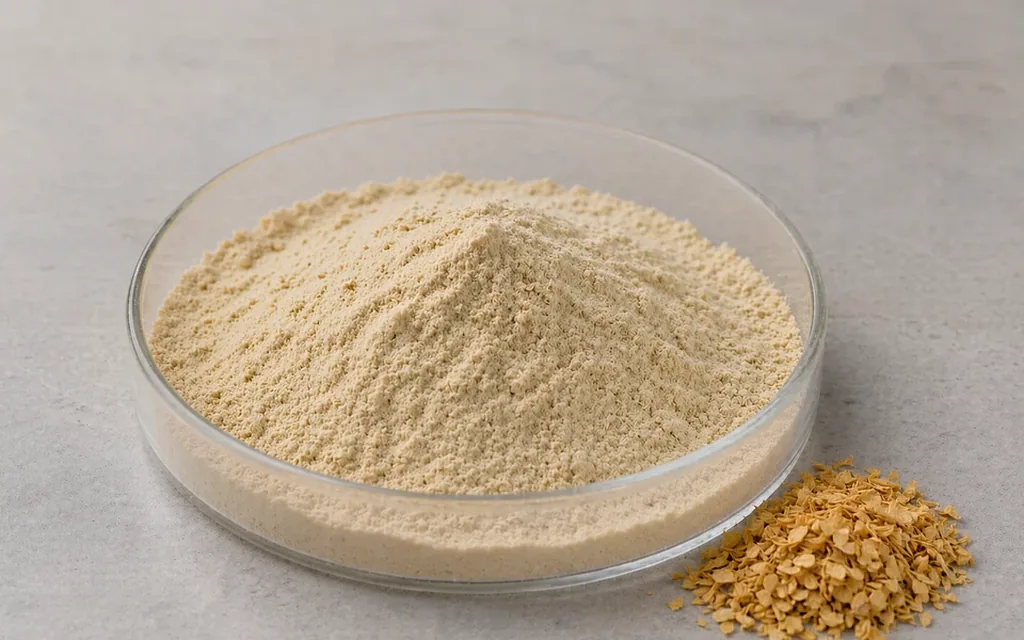
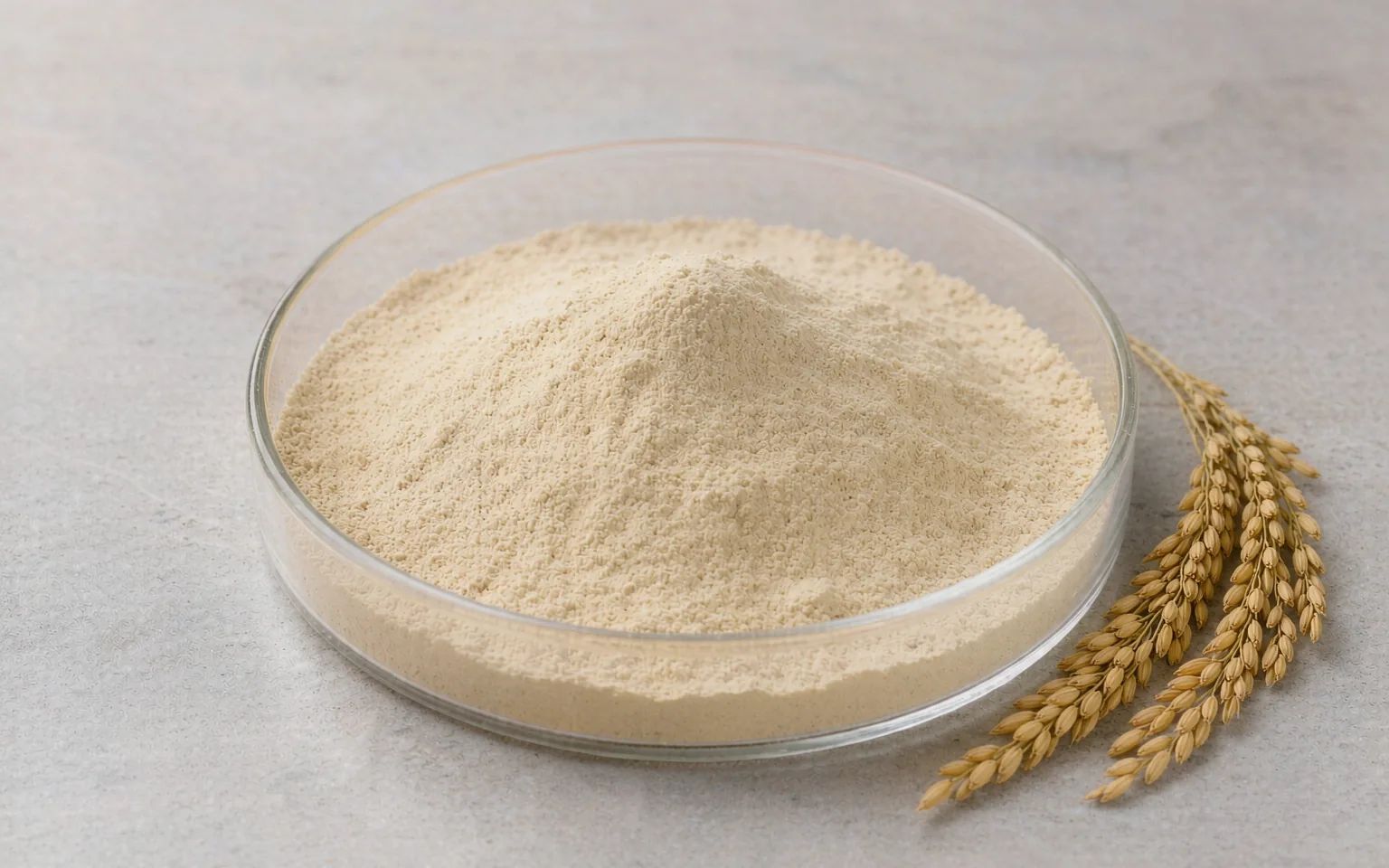
Rice protein is the quiet ingredient in plant-based formulation. It does not compete on protein percentage and it does not carry a marketing story the way pea does, but it solves two problems that are expensive to solve any other way: it is hypoallergenic, and it tastes almost of nothing.
Those two properties make it the usual partner for pea protein and the default choice where a formula has to be gentle on sensitive consumers.
Product Specifications
| Item | Specification |
|---|---|
| Product Name | Rice Protein (from brown rice, Oryza sativa) |
| Protein (dry basis, Kjeldahl) | 80% min (organic grade available) |
| Appearance | White to off-white fine powder |
| Moisture | 7.0% max |
| Flavour | Nearly neutral, low residual starch |
| Standard | Food grade; organic certified lots available on request |
| Allergen Status | Free from the major eight allergens; gluten-free |
| Packaging | 20 kg / 25 kg kraft bag with food-grade inner liner |
| Shelf Life | 24 months (sealed, cool and dry storage) |
| MOQ | 25 kg for bulk; samples available on request |
Applications
- Sensitive-consumer nutrition – paediatric and clinical formulas where the allergen profile is the first screening criterion
- Pea protein blends – the standard pairing that closes the lysine gap in a plant-based protein system
- Neutral-tasting beverages – products where a masking system would cost more than the protein
- Bakery and extruded snacks – fortification where a beany note would be unacceptable in a sweet profile
The two things rice protein is bought for
Allergen profile. Rice sits outside the major allergen families, and rice protein is gluten-free by nature. In markets where a soy or wheat declaration forces a label change, or in products aimed at consumers who have already been diagnosed rather than those who are avoiding, this is often the deciding factor rather than any nutritional figure.
Flavour neutrality. Because the flavour load is so low, a formula can reach an acceptable taste with less masking, which typically removes cost and shortens the ingredient list at the same time. For sweet applications this is a real advantage, since the flavour systems for plant proteins are usually built for savoury profiles and behave poorly in a dessert.
The trade-off is the amino-acid profile: rice protein is low in lysine. That is exactly why it is almost always bought as a partner rather than on its own, and we can quote a pre-blended ratio if that suits your process better than blending in house.
Regulatory status by market
Rice protein is the simplest protein on this site from a regulatory standpoint: rice is a traditional food everywhere, nothing needs authorising, and there is no allergen declaration to make. The questions that actually matter to a buyer are therefore contaminant control and the specification, not market entry.
United States — GRAS
European Union — traditional food
United Kingdom — traditional food
Japan — food material
Indonesia, Malaysia, Vietnam and Thailand — food ingredient
Korea — 식품원료
Frequently Asked Questions
Rice protein is bought for two reasons above all, and the questions below are the ones that decide whether a grade is usable in your market. For how the pairing works in practice, see our note on building a soy-free protein blend.
Why is rice protein almost always blended rather than used alone?
Rice protein is limiting in lysine and pea protein is limiting in methionine, so the two cover each other and the blend reaches a complete amino-acid profile. The ratio is normally set by the amino-acid target rather than by cost, and if blending in house does not suit your process we can quote a pre-blended ratio instead of two separate raw materials.
What is the position on inorganic arsenic?
Rice takes up inorganic arsenic from soil and water more readily than most crops, and drying concentrates the grain further, so arsenic is the specification point that separates one rice protein from another. We test it on every lot and quote the result on the certificate of analysis. Tell us the limit your destination market requires and we will confirm whether the grade meets it before you commit to a volume.
Is rice protein gluten-free, and can we claim it?
Rice contains no gluten, so the protein is gluten-free by nature. Lots can be tested by R5 sandwich ELISA against the 20 mg/kg threshold that both the EU rules and the US rules use for a gluten-free claim. If the claim is going on pack, ask for the test report on the actual lot rather than a general statement, since that is what an auditor will look for.
How well does it disperse, and what does that mean for texture?
Rice protein is only partly soluble, so in a beverage the texture is governed by particle size and shear rather than by dissolution. Fine-mesh and jet-milled grades give a smoother mouthfeel but compact more in the bag and generate more dust; a coarser grade handles better and performs well in bakery. Choose on the application, and plan a hydrocolloid if the product is a drink.
Is rice protein a declared allergen?
No. Rice is not on the EU allergen list or the US major-allergen list, and the protein is gluten-free by nature, which is why it is specified for paediatric and clinical nutrition where the allergen profile is the first screening criterion rather than a secondary consideration. The allergen statement is supplied with every lot.
Tell us the application and whether you need an organic lot, and we will send the specification, COA and a sample. Request a quote