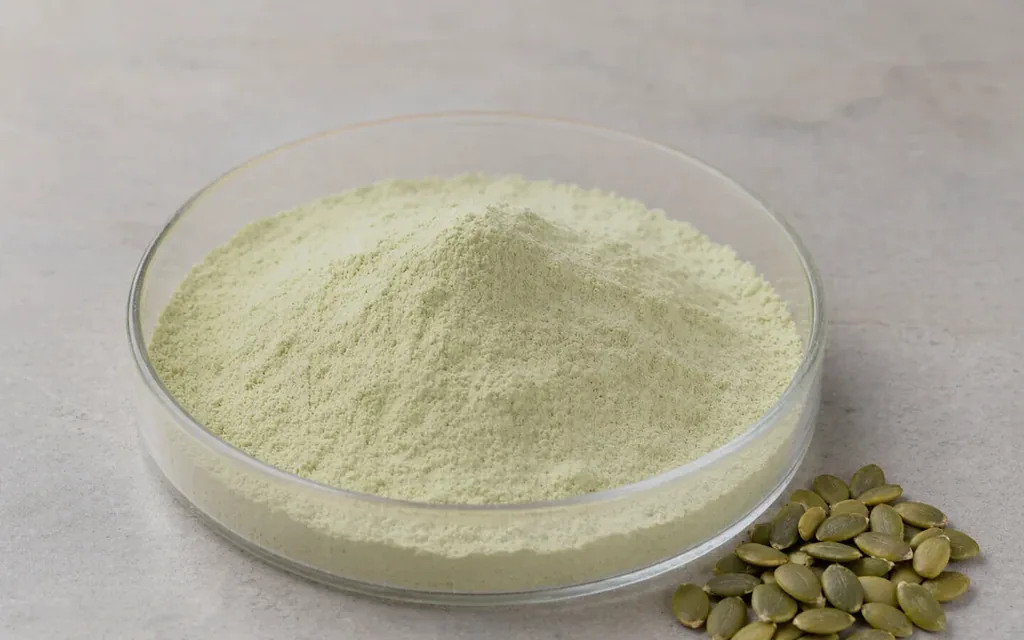
Pumpkin seed protein is the quiet workhorse of the seed-protein group: a 60% protein powder with a naturally green cast, a mild nutty taste, and none of the allergen baggage that soy carries. We supply it in two routes – a conventional cold-pressed grade and a supercritical CO2-extracted grade – because the difference between them decides whether it fits your shelf life, not just your spec sheet.
We supply pumpkin seed protein as a bulk ingredient for bar, beverage and savoury applications, with the grade matched to how much residual fat your matrix can tolerate.
Product Specifications
| Item | Specification |
|---|---|
| Product Name | Pumpkin Seed Protein (Cucurbita pepo) |
| Protein (dry basis) | 60% min (65% grade on request) |
| Grades | Cold-pressed (residual fat 6-8%) and supercritical CO2-extracted (fat approx. 1-2%) |
| Appearance | Pale green to green-beige fine powder |
| Moisture | 8.0% max |
| Mesh | 80 mesh typical, finer on request |
| Heavy Metals | Cadmium specified and reported per batch |
| Standard | Food grade, Non-GMO |
| Packaging | 20 kg / 25 kg kraft bag with food-grade inner liner |
| Shelf Life | 24 months (sealed, cool and dry storage) |
| MOQ | 25 kg for bulk; samples available on request |
Applications
- Protein bars and energy balls – the pressed grade binds well in low-water matrices
- Plant beverages and shakes – the CO2 grade, where residual fat would shorten shelf life
- Savoury soups, sauces and seasonings – the natural green colour and nutty note work in its favour
- Sports nutrition blends – paired with pea and rice to round out the amino-acid profile
Why there are two grades, not one
Pumpkin seeds carry a meaningful lipid fraction, and that fraction is what drives the two failure modes buyers meet first: rancidity on the shelf and a grassy note that grows with storage time. Mechanical pressing leaves 6-8% fat behind – acceptable in a bar, risky in a beverage held for months. Supercritical CO2 extraction strips that fat down to 1-2% without solvents or heat damage, which is why the CO2 grade tastes milder, stores longer and costs more. Choosing between them is a shelf-life decision, so tell us the matrix and the target dating and we will quote the grade that fits.
Two further points belong in every sourcing conversation. First, the colour: the green comes from chlorophyll carried in the seed itself and varies with origin and crop year – it is natural, not a defect, and the CO2 grade is usually the lighter of the two. Second, cadmium: pumpkin seeds are efficient accumulators of soil cadmium, so we specify it per batch and report the figure on every COA rather than quoting an annual average that no longer describes the drum in your warehouse.
Regulatory status by market
Pumpkin seed is a long-established food, and the protein prepared from it is sold as a food ingredient across Asia without any pre-market authorisation. The US position rests on GRAS notices; the European conclusion for the defatted protein, as distinct from the seed itself, is not settled, so it is not stated below.
United States — GRAS
Japan — food material
Indonesia, Malaysia, Vietnam and Thailand — food ingredient
Korea — 식품원료
Frequently Asked Questions
What is the difference between the cold-pressed and supercritical CO2 grades?
The pressing route leaves 6-8% residual fat in the powder; supercritical CO2 extraction removes solvents and heat from the equation and brings fat down to roughly 1-2%. Practically, the CO2 grade tastes cleaner, keeps longer and suits beverages, while the pressed grade costs less and works well in bars and bakery.
Why is pumpkin seed protein green?
The colour comes from chlorophyll and related pigments naturally present in the seed. It shifts with seed origin and crop year, and it is not a quality defect. If a lighter powder matters for your application, the CO2-extracted grade is usually the paler option.
Is pumpkin seed protein a declared allergen?
Pumpkin seed is not among the major eight allergens, so it avoids soy and peanut style labelling in most markets. Seed allergies in general are rare but not zero, so we recommend the usual advisory review for your destination market.
What about heavy metals, especially cadmium?
Pumpkin seeds accumulate cadmium from soil more readily than most crops, so we set a specification and report cadmium on every batch COA rather than relying on periodic checks. Typical figures sit comfortably below EU food-grade limits, and we can share current lot data with your sample.
How does it behave in a drink?
The powder disperses readily but, like most seed proteins, will settle without stabilisation – gums or system viscosity do the work. The CO2 grade is the better choice for ready-to-drink formats because there is less fat to oxidise over shelf life.