Every other colour in this range is extracted and used as it grew. Sodium copper chlorophyllin is not: it is made by saponifying natural chlorophyll, then swapping the magnesium at the centre of the molecule for copper, which turns an oil-soluble, easily faded pigment into a set of stable, water-soluble sodium salts. That one chemical step — not marketing — is why it holds an intense green through heat, light and months on the shelf. It is also the reason the United States treats it differently from every other colour we supply, in one way that helps and one that does not.
We manufacture a food grade of 95.0% minimum total copper chlorophyllins. The analytical limits in the table below are quoted from 21 CFR 73.125, because those are the figures a US-facing customer will eventually be asked to demonstrate.
Product Specifications
| Item | Specification |
|---|---|
| Product Name | Sodium Copper Chlorophyllin (chlorophyllin copper complex, sodium salt) |
| CAS No. | 11006-34-1 |
| EINECS | 234-242-5 |
| Colour index | INS 141(ii) / E 141(ii) |
| Assay | Total copper chlorophyllins 95.0% min, on the sample dried at 100 °C for 1 hour |
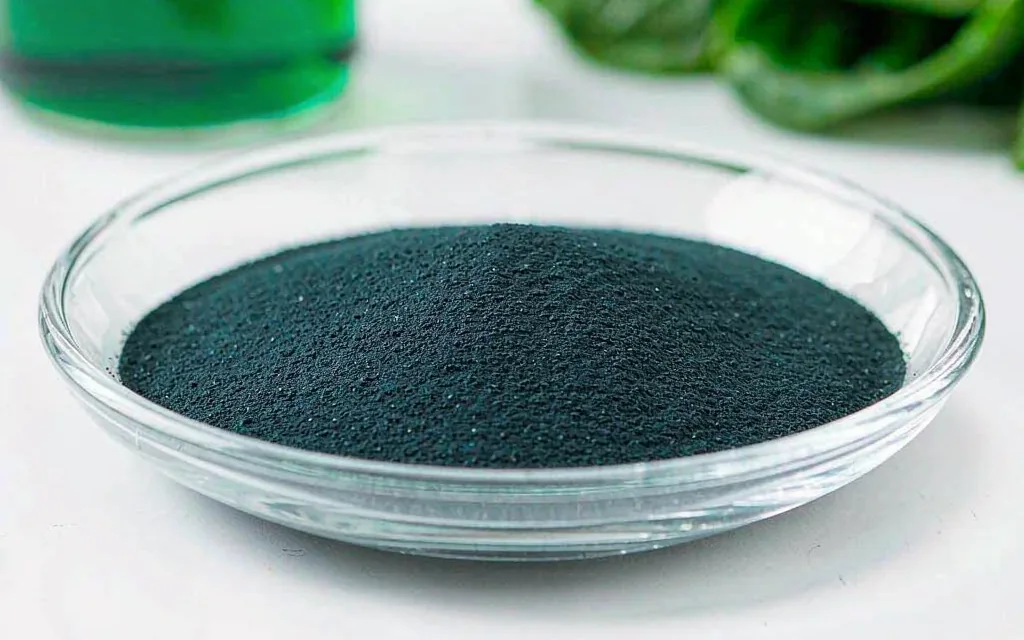
| Appearance | Dark green to blue-black fine powder |
| Solubility | Water-soluble; dissolves readily in alkaline solution |
| Moisture | 5.0% max |
| Total copper | 4.0–6.0% |
| Free copper | 200 ppm max |
| Absorbance ratio | A405/A630 between 3.4 and 3.9 |
| Solvent residues | Acetone, ethanol and hexane: 50 ppm max, singly or in combination |
| Heavy metals | Lead 10 ppm max; arsenic 3 ppm max; mercury 0.5 ppm max |
| Standard | Food grade; analytical limits as set out in 21 CFR 73.125 |
| Packaging | 25 kg fibre drum with food-grade inner liner; 1 kg and 5 kg foil bags for samples |
| Shelf Life | 24 months sealed, stored cool and dry, protected from light |
| MOQ | 25 kg for bulk; samples available on request |
Applications
- Confectionery panning and sugar shells — the green survives a hot cook, and the copper complex does not bleed or brown the way a leaf-derived powder can
- Instant powders, sachet drinks and tablet coatings — fully water-soluble, so it colours clear systems an oil-soluble chlorophyll cannot enter
- Frozen desserts and non-dairy alternatives — a clean green with none of the yellow undertone or hay-like note a dried-leaf powder carries
- Fruit preparations, sauces and seasonings — stable in moist, acidic matrices where magnesium chlorophyll would drift toward olive
- Dietary supplements — a colouring ingredient for capsules, tablets and gummies, supplied against a supplement specification where the market permits
What the process step decides
The route is worth knowing because it explains every line above. Chlorophyll is solvent-extracted from dried alfalfa, saponified to strip the phytyl chain and open the porphyrin ring, and only then does the copper go in, replacing the magnesium. Each step leaves a signature in the COA: an incomplete saponification shows up as colour drift in storage; loose control of the copper substitution shows up as free copper above the 200 ppm line; careless drying shows up as moisture above 5% and caking in the drum. A certificate that reports the assay, both copper figures, moisture and the absorbance ratio together is a certificate from a plant that controls these steps — which is the substance behind any supplier claim.
The two copper figures on a chlorophyllin COA are not interchangeable
This is the specification point most often got wrong in quotations. There are two different copper values on a compliant chlorophyllin specification, and they answer two different questions. Total copper, between 4.0% and 6.0% under 73.125, is the copper chelated into the chlorophyllin molecule itself — it tracks the assay and tells you how much genuine colourant is in the drum. Free copper, not more than 200 ppm, is the unbound residue left over from the copper-salts step of manufacture. A quotation that states only “copper 0.25% max” is quoting the second figure and telling you nothing about the first, so ask for both on the COA rather than accepting a single line.
The third figure worth demanding is the absorbance ratio A405/A630, between 3.4 and 3.9 under the listing. It is the closest thing this material has to a fingerprint: it moves when the chlorophyllin has degraded or been diluted with degradation products, and it is the first figure a serious COA will not omit. Solvent residues belong in the same conversation — the extraction is a solvent process, and 73.125 caps acetone, ethanol and hexane at 50 ppm combined.
Source material matters too. The listed US identity describes chlorophyll extracted from alfalfa (Medicago sativa). Grades from other green plant material are common in the market, so if the identity route is going to matter for your market, state it on the enquiry and we will quote the matching grade rather than assuming one.
Where it can be used — the US position is narrow by design
The American listing dates from a 2002 Federal Register notice (67 FR 35431) and needs no batch certification, but the food use it grants is a single category: citrus-based dry beverage mixes, at not more than 0.2% of the dry mix. Nothing else — no confectionery, no dairy, no beverages at large. Some supplier pages advertise a broad FDA approval for this material, and at least one quotes a CFR section number that does not exist; the actual section is 73.125. If the target market is the US, that conversation is short, and it is worth having before the formulation is started rather than after.
The European position is different: E141(ii) is an authorised colour under Regulation (EC) No 1333/2008, with purity criteria in Regulation (EU) No 231/2012, and it is used across confectionery, desserts, beverages, dairy products and fruit preparations. Note the distinction inside E141 itself — E141(i) is the oil-soluble copper chlorophyll, E141(ii) is the water-soluble chlorophyllin supplied here. Category permissions and maximum levels are set per category, so have them checked against the destination market before the recipe is fixed.
One handling note specific to this material: because it is supplied as sodium salts, a solution of it is typically alkaline, so it is worth checking what the addition does to the pH of a lightly buffered system before the recipe is locked. The same property is what makes it dissolve readily where a chlorophyll extract would sit on the surface. We standardise each batch to the colour value your formula requires and can discuss the carrier options for liquid dosing.
Tell us the application and the destination market, and we will send the grade that matches — including the specification lines above on the batch COA. Request samples and COA
Regulatory status by market
Chlorophyllin is the clearest case on this site where a product is fully authorised in one market and barely usable in another. Europe treats it as a mainstream additive with an E number; the United States allows it in a single narrow category. Reading only the word “permitted” without the category is how shipments get held.
United States — 21 CFR 73.125
European Union — E141(ii)
United Kingdom — E141(ii)
Japan — 指定添加物 銅クロロフィリンナトリウム
Indonesia, Malaysia, Vietnam and Thailand — INS 141(ii)
Korea — 클로로필 · 구리클로로필린나트륨
Frequently Asked Questions
Which regulatory entry does sodium copper chlorophyllin fall under?
In the EU it is E 141(ii), copper chlorophyllins; in the US it is listed at 21 CFR 73.125 for citrus-based dry beverage mixes up to 0.2% in the finished beverage powder, which is a deliberately narrow permission. The EU entry is broader, so the destination market decides what you can claim – check the use list before you build the formula around it.
How stable is the green compared with chlorophyll itself?
Far more stable. Replacing the magnesium at the centre of the chlorophyll molecule with copper keeps the colour green under heat and light where natural chlorophyll would turn olive within a batch cycle. It still fades under prolonged strong light and at low pH, so it suits neutral-to-mildly-acid systems best.
Is the copper content a labelling issue?
The copper is chemically bound and part of the colourant definition; the permitted figure is written into the E 141(ii) and 21 CFR specifications. It is not counted as added copper for nutrition labelling, but the colourant must be declared by its functional class and name where used.
What grade is supplied for pharmaceutical or oral-care use?
We supply food grade as standard and can quote grades with tighter metal and micro specifications for oral care and pharma-adjacent applications. Tell us the end use and the governing spec, and we will confirm the grade that fits rather than over-selling.
What is the MOQ and sampling policy?
25 kg is the bulk MOQ, and free samples with current lot COA are available before commitment – we would rather the colour be proven in your matrix than argued about on a spec sheet.