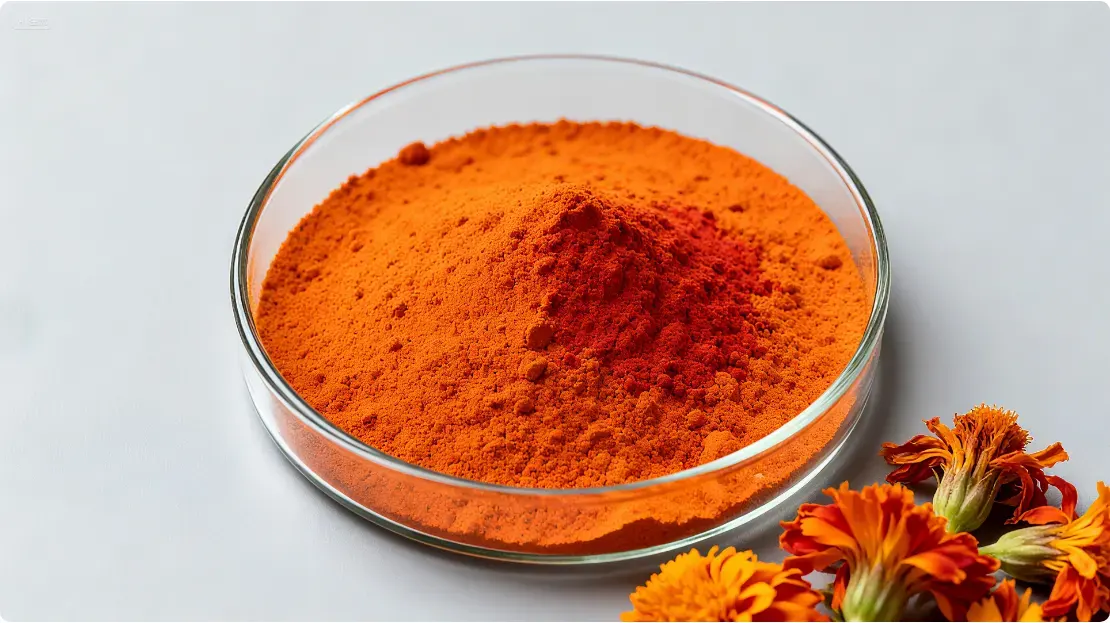
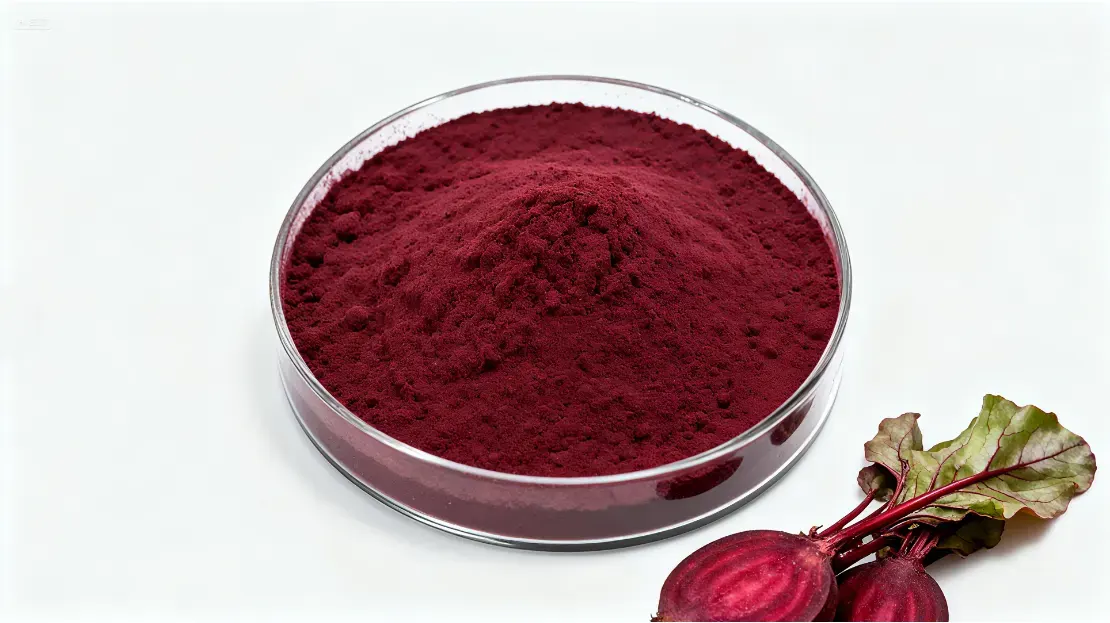
Beetroot Red (INS 162, E162) is the aqueous extract of red beetroot, Beta vulgaris, and the only commercially significant source of betalain pigments. Betanin supplies 75–95% of the betacyanin fraction, betaxanthins add the yellow-orange note, and the balance between the two is what decides the shade you actually see. Because betalains are neither anthocyanins nor carotenes, beetroot red behaves differently from berry-derived reds: it holds its hue across roughly pH 3 to pH 7 and does not swing blue or violet as acidity falls away. We supply beetroot red as a spray-dried powder and as a liquid concentrate, with colour value declared per batch.
How to read a beetroot red colour specification
Two suppliers can both quote “E50” and still finish at visibly different shades in your product. Three numbers decide it:
- Colour value (E 1%, 1 cm, 535 nm). Absorbance measured in water at the betanin maximum, 535 nm. This is the number you dose against: a higher value means less powder per batch. Our standard spray-dried grade is E50.
- Betanin content. Colour value and betanin percentage are related but not interchangeable. A nominal colour value carried by a wide betaxanthin or degradation fraction reads orange-brown rather than clean red once it is diluted in a pale matrix.
- Carrier. Spray-dried beetroot red is normally standardised on maltodextrin. The carrier is what the colour value is diluted with, so a cheap powder on a heavy carrier simply means you dose more of it. Ask what the carrier is, and whether it has to be declared on your label.
Specify the form as well as the number. Powder blends more easily into dry mixes and is simpler to store; liquid concentrate disperses faster in beverages and syrups and removes dust handling, but carries a shorter shelf life and needs cool, dark storage.
Heat is the limiting factor, not pH
Betalains tolerate a wider acidity window than most natural reds, but they degrade under sustained heat, and that single fact shapes where beetroot red belongs:
- Comfortable fit: cold-filled and chilled products, gels and jellies, frozen desserts, confectionery and gummies, icings and fillings, and dry blends where colour is added after any thermal step.
- Needs care: beverages and sauces that take a full pasteurisation or UHT cycle. Dose as late in the process as your line allows, keep hold time at temperature short, and build in a measured colour loss across the fill.
- Poor fit: long bakes, retort, and any application with a prolonged hold much above 60 °C.
After heat, oxygen and light are the next causes of fade. Low dissolved oxygen at fill, UV-barrier or opaque packaging, and a tightly controlled headspace all buy shelf life. Antioxidants such as ascorbic acid are sometimes used to slow the shift, but the effect is strongly matrix-dependent, so it has to be trialled rather than assumed. If shade loss appears between batches without a process change, check process water and contact with bare iron or copper in pumps and pipework before you change the colour.
Switching from Red 40 or carmine: what actually changes
Moving a line onto beetroot red is rarely a one-for-one substitution. Four things move at once:
- Dose rises sharply. Certified synthetic reds are dosed in tens of ppm; beetroot red is dosed orders of magnitude higher for the same visual depth. Compare suppliers on cost per coloured unit of finished product, never on price per kilo.
- Light fastness becomes the deciding test. Clear packaging, illuminated displays and exterior-facing surfaces are where synthetic-to-natural switches most often fail. Test in the real pack, under real light, for the real shelf life.
- The hue lands pink-magenta. Beetroot Red will not reach a true saturated fire-engine red on its own. In practice it is blended with carotenoid yellows or an orange-red partner such as paprika oleoresin, which is why formulators usually treat the two as a pair.
- Flavour carries. Beet is a vegetable with its own notes. At low dose this is invisible; at the dose needed for a deep shade, earthy or cooked-beet character can surface. Where that matters, ask for a deodorised or reduced-earthy grade rather than accepting the standard one.
Regulatory status by market
Beetroot red is recognised as a colour in each of the six markets below, but its legal identity changes at each border: a colour additive with an E number in Europe, a vegetable juice or a beet powder in the United States, an existing food additive in Japan. An E162 declaration copied onto a US order describes a route the United States does not use, which is why each market is set out separately below.
United States — 21 CFR 73.39, 73.260 and 73.40
European Union — E162
United Kingdom — E162
Japan — 既存添加物 ビートレッド
Indonesia, Malaysia, Vietnam and Thailand — INS 162
Korea — 천연첨가물 비트레드 (INS 162)
What to put in the purchase order
Beetroot Red grades are not interchangeable, so the more of this you state up front, the closer the first sample lands:
- Form: spray-dried powder or liquid concentrate
- Colour value (E 1%, 1 cm, 535 nm) and expected betanin range
- Carrier, and the allergen statement that goes with it
- Intended application and target shade
- Destination market, so permitted-use limits and labelling are matched to it
- Heavy metals, microbiology and pesticide residue limits per your internal specification
- Per-batch documents required: COA, TDS, MSDS, Kosher and Halal certificates
Which Name Belongs on the Specification
One material travels under several names, and choosing between them is a paperwork decision rather than a product one. Beetroot Red is the name to specify: it is the European additive identity behind E162, and it is also the name FDA used for its dedicated listing at 21 CFR 73.39. The shortened English form you will still meet on some certificates of analysis belongs to the Codex entry for INS 162, and the Japanese and Korean lists carry their own transliterations of it. Quotations written in different conventions describe the same material, which is worth knowing before you compare them, because a supplier using one and a buyer using the other can spend a week confirming that nothing was actually in dispute.
Neither name should be confused with beetroot powder. The powder is the dried root, sold as a food ingredient and bought for its vegetable identity and its fibre. Beetroot red is the standardised colour preparation extracted from that same root, declared by colour value and dosed for shade alone. Buyers occasionally compare the two on price per kilogram without adjusting for the fact that one is a whole food and the other is a concentrated colorant, which is not a like-for-like comparison.
Frequently Asked Questions
What is the difference between beetroot red and beetroot powder?
Beetroot powder is the dried root, sold as a food ingredient and bought for its vegetable identity and its fibre. Beetroot red is the standardised colour preparation extracted from that same root, declared by colour value and dosed for shade alone. Comparing the two on price per kilogram is not a like-for-like comparison, because one is a whole food and the other is a concentrated colorant.
What colour value does your spray-dried grade carry?
Our standard spray-dried grade is E50, measured as E 1%, 1 cm at 535 nm in water, at the betanin maximum. Colour value is the number you dose against: a higher value means less powder per batch. Colour value and betanin percentage are related but not interchangeable, so a nominal figure carried by a wide betaxanthin or degradation fraction reads orange-brown rather than clean red once it is diluted in a pale matrix.
Can beetroot red survive pasteurisation or UHT?
Betalains tolerate a wider acidity window than most natural reds and hold hue from roughly pH 3 to pH 7, but they degrade under sustained heat. Beverages and sauces that take a full pasteurisation or UHT cycle need care: dose as late in the process as the line allows, keep hold time at temperature short, and build in a measured colour loss across the fill. Long bakes, retort and any application with a prolonged hold much above 60 °C are a poor fit.
Will beetroot red give a true fire-engine red on its own?
No. The hue lands pink-magenta, and beetroot red will not reach a saturated fire-engine red by itself. In practice it is blended with carotenoid yellows or an orange-red partner such as paprika oleoresin, which is why formulators usually treat the two as a pair.
Is beetroot red permitted in the United States?
It is a listed colour additive exempt from certification, and the answer depends on the form. A dedicated entry, 21 CFR 73.39, was added by a final order of 6 February 2026 (91 FR 5295), but its effective date was delayed indefinitely on 20 March 2026 (91 FR 13965) after objections were filed, so it cannot be relied on yet. The listings that apply today are 73.260 for beet juice and 73.40 for dehydrated beets and beet powder. A further-purified betanin fraction has no listing at all.
Send us the target shade and the application and we will come back with a grade recommendation and a sample rather than a price alone. If your red depends on a blend, the orange-red side is usually capsanthin; the full range sits under natural colours.