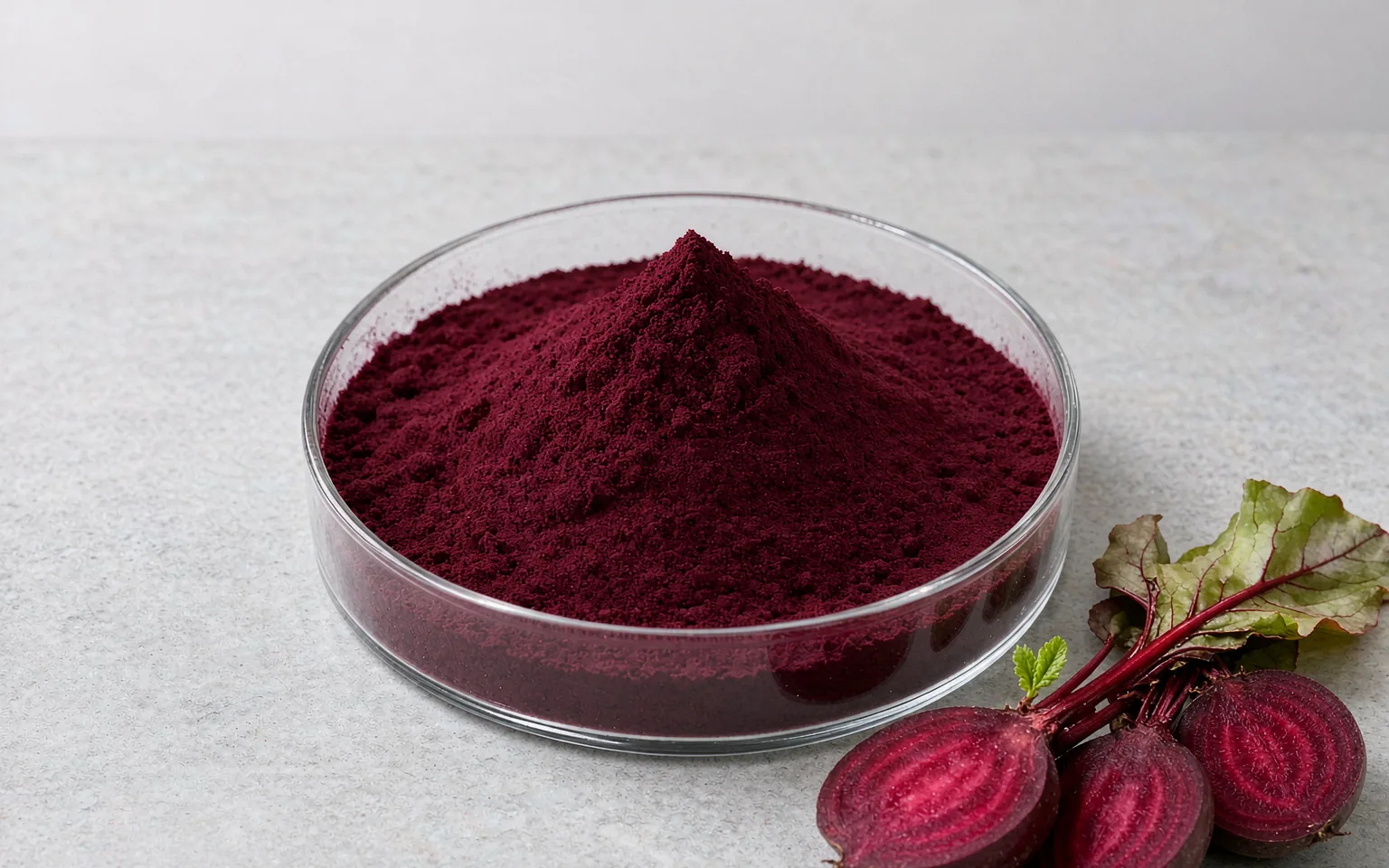
Beetroot powder is sold into two markets that look similar and are bought for completely different reasons. One buyer wants the red-purple shade; the other wants dietary nitrate and does not much care what colour it is. Specifying the same material for both is the most common mistake with this ingredient.
We supply it in whole-root and juice grades, with betalain and nitrate figures reported separately so the specification can match the intended function.
Product Specifications
| Item | Specification |
|---|---|
| Product Name | Beetroot Powder (Beta vulgaris) |
| Grades | Whole-root powder and juice powder |
| Appearance | Deep red-purple fine powder |
| Betalain Content | Reported per batch |
| Dietary Nitrate | Reported per batch on request |
| Moisture | 8.0% max |
| Standard | Food grade; organic lots quoted when required |
| Packaging | 20 kg / 25 kg kraft bag with food-grade inner liner |
| Shelf Life | 18 months sealed; colour grades kept away from light |
| MOQ | 25 kg for bulk; samples available on request |
Applications
- Sports and performance nutrition – bought for dietary nitrate, where the colour is simply tolerated
- Red-toned bakery and sugar confectionery – a declared vegetable ingredient carrying the shade, for labels that prefer a whole food over a separated colorant
- Beverages and powdered blends – colour and a recognisable beet flavour in one ingredient
- Meat analogue products – contributing a red tone to plant-based formulations
Pick the grade by function, not by colour
If the function is colour, the specification that matters is the betalain content and how stable it stays in your system. Betalains hold their shade across a mildly acidic to neutral range but are sensitive to heat and to prolonged light exposure, so a baked or light-packed product will need a higher dose than the same formula sold in opaque packaging. This is also where beetroot powder differs from a standardised beet red color preparation: the powder is a food ingredient that carries colour, while the color preparation is standardised and dosed for colour alone.
If the function is nitrate, the colour is irrelevant and the nitrate figure is the whole specification. Raw material, growing conditions and the drying process all move that figure substantially, so it needs to be reported per batch rather than assumed from a typical value. This is the performance-nutrition positioning, and it is judged on the nitrate content rather than on appearance.
Where the colour ends up matters in dry systems. Betalains are water-soluble, so in a dry blend the powder sits as discrete red-purple particles until the product is hydrated. That keeps the shade from migrating onto neighbouring components in a premix, but it also means the colour only develops once there is moisture: in a drink mix, a gel or a dough. Dusting it onto a surface that stays dry will read as speckle rather than as an even shade, so dosing expectation should be set by the finished product’s water activity, not by the look of the dry blend.
One flavour point applies to both. The earthy note in beetroot comes largely from geosmin, and its level depends on the raw material and on whether the powder is made from whole root or from juice. Juice-grade powder is the usual answer when the earthy character has to be kept low, while whole-root powder retains more of the fibre and the natural matrix.
Tell us whether the target is the shade or the nitrate figure, and we will send the grade with the matching per-batch analysis. Request the per-batch COA
Regulatory status by market
Beetroot powder is often ordered as a colour and regulated as a vegetable, and that gap is the source of most declaration errors around it. The whole dried root is a food ingredient; E162 is a colour additive prepared from it. If you need the additive identity rather than the food one, the product is beetroot red rather than this powder.
United States — food ingredient; 73.40 for colour use
European Union — traditional food, not E162
United Kingdom — traditional food, not E162
Japan — food material, not ビートレッド
Indonesia, Malaysia, Vietnam and Thailand — food ingredient
Korea — 식품원료
Frequently Asked Questions
What is the difference between whole-root beetroot powder and beet juice powder?
Whole-root powder is the dried, milled root – fibre, sugars and pigment together – and it behaves like a flour with colour. Juice powder is the concentrated expressed juice dried on a carrier: much higher betalain concentration per gram, less fibre, and a different cost structure. Applications that need colour plus bulk use whole-root; applications that need colour strength use juice powder.
Why did the red colour fade in my baked product?
Betalains are heat-sensitive: in a baked crumb the vivid red of the dry mix fades substantially by the time the product cools, and pH below about 4 pushes them towards violet. This is degradation chemistry, not a quality defect – we cover the dose, pH and process levers in our beetroot fading guide, and for high-heat applications a colour-stable alternative is usually the honest recommendation.
Is the nitrate content of beetroot powder specified?
Dietary nitrate varies with growing conditions and we report it per batch on request. For sports-nutrition positioning where nitrate is the functional story, ask for the nitrate-assayed lots so your claim rests on the certificate rather than the average.
Does beetroot powder get used as a colour or as an ingredient?
Both, and the spec sheet should say which. As an ingredient (smoothies, bakery, pasta) the whole-root powder is quoted on typical analysis. As a natural colour, the juice powder is quoted on betalain content per batch. Mixing the two purchasing framings is the most common quoting mistake we see.
How hygroscopic is the powder?
Noticeably – beetroot powder picks up atmospheric moisture and will cake if left open. Sealed liner packaging and dry storage keep it free-flowing; the same advice applies to tomato powder, and both are handled the same way in our packing.