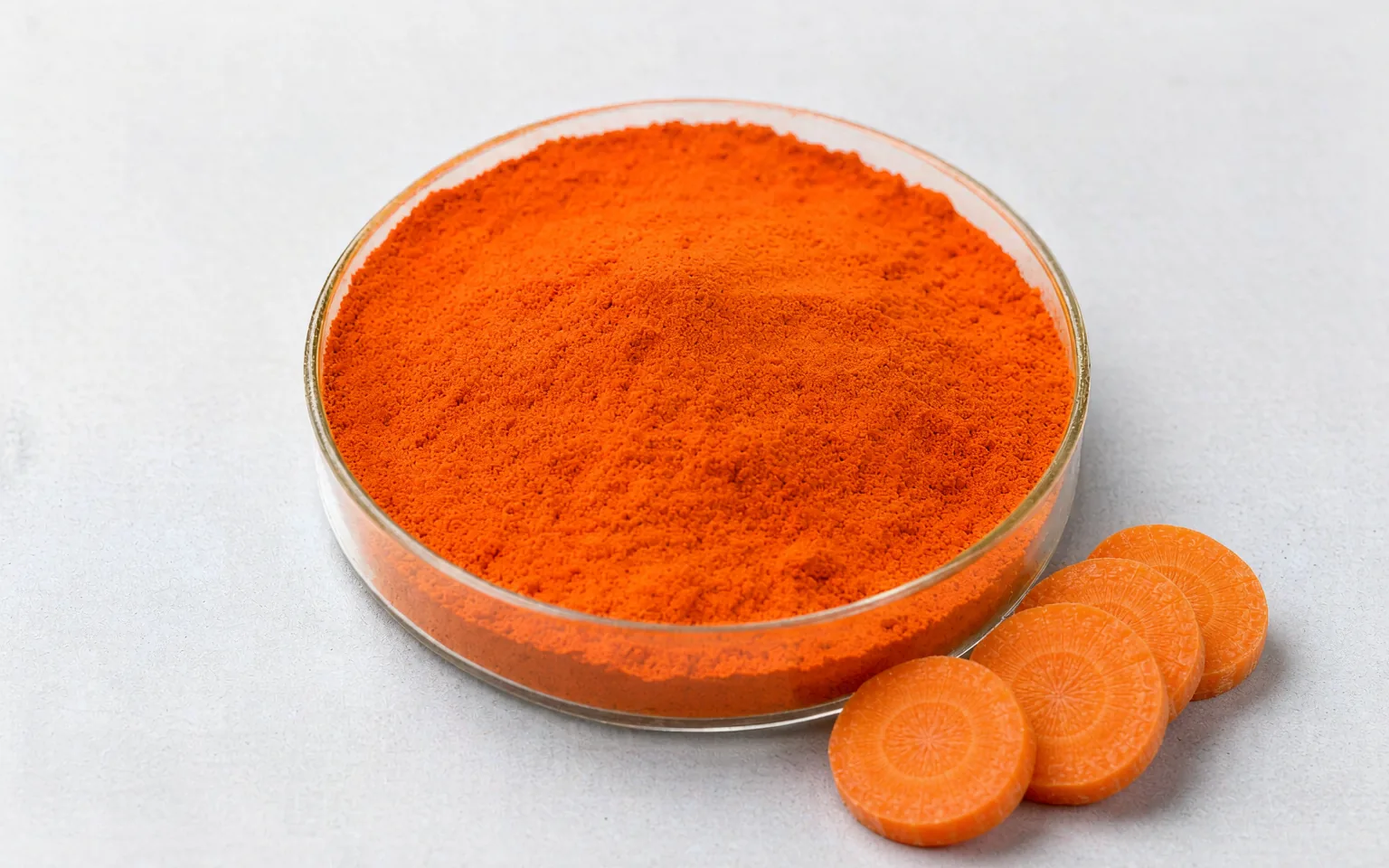
Carrot powder is one of the few ingredients that does two jobs at once. It delivers an orange shade and it brings sweetness at the same time, which makes it useful in reformulation work where both colour and sugar are being taken out of the formula and nobody wants to add two separate ingredients back in.
We supply it with the carotene level standardised, so the colour contribution is predictable rather than dependent on the harvest.
Product Specifications
| Item | Specification |
|---|---|
| Product Name | Carrot Powder (Daucus carota) |
| Appearance | Orange to deep orange fine powder |
| Carotene Content | Standardised grades available on request |
| Moisture | 8.0% max |
| Mesh | 80 mesh typical |
| Standard | Food grade; organic certified lots available on request |
| Packaging | 20 kg / 25 kg kraft bag with food-grade inner liner |
| Shelf Life | 18 months sealed, protected from light |
| MOQ | 25 kg for bulk; samples available on request |
Applications
- Bakery and snacks – natural orange colour with a mild sweetness carried in the same ingredient
- Broths, gravies and seasoning blends – body and colour in savoury bases
- Confectionery and coatings – where a warmer orange is wanted without a synthetic colorant
- Nutritional blends – carotenoid contribution alongside the fibre and sugars naturally present
What to know before you dose it
Provitamin A is a label opportunity worth checking. The same carotene that carries the orange also brings vitamin A activity, so in a snack, a beverage or a blend the ingredient can support a nutrition declaration in markets where the conversion rules allow one. Whether that is worth claiming depends on the dosage the colour work already demands and on the declaration thresholds of your destination market, so it is worth raising both figures together rather than treating the colour and the nutrition panel as separate conversations.
The carotenoid figure is the spec that matters. Beta-carotene is sensitive to heat, oxygen and light, and it degrades during drying and again during storage if the packaging is not light-blocking. Two carrot powders can look identical in a sample jar and behave very differently after a month on a shelf, so colour contribution should be agreed as a measured carotene level rather than as an appearance description. We standardise to the level you need so that batch-to-batch dosing stays comparable.
The sweetness is real and it has to be counted. Carrot powder carries naturally occurring sugars, which is an advantage when the goal is replacing part of the added sugar, but the same sugars are hygroscopic and can drive caking in a powdered blend. In a dry mix this normally shows up as clumping in the bag rather than as a formulation failure, and it is solved with the packaging format and a moisture specification rather than with a different ingredient.
Where the intent is colour, carrot powder sits in the warm orange range and competes with turmeric-based yellows and annatto. Where the intent is sugar reduction, it is best treated as a modest contributor that also happens to colour the product, not as a bulk sweetener replacement.
Tell us the target shade and whether the sweetness needs to be counted in the nutrition panel, and we will quote the matching carotene grade. Request samples and specification
Regulatory status by market
Carrot powder is a food ingredient first and a colour second, and the two uses sit under different rules in the United States. Sold as a vegetable powder it needs nothing; used to colour, it falls under the vegetable juice listing. Buyers who treat the powder as an orange colourant without checking which of the two applies are the ones who run into declaration problems.
United States — food ingredient, or 73.260 for colour use
European Union — traditional food
United Kingdom — traditional food
Japan — food material
Indonesia, Malaysia, Vietnam and Thailand — food ingredient
Korea — 식품원료
Frequently Asked Questions
Can the carotene content be standardised to a fixed figure?
Carotene varies meaningfully with variety and harvest conditions, so our standard offer quotes the analysed figure per batch; standardised grades that guarantee a minimum carotene level are available on request and are priced for the blending work they require. For colour-critical applications, tell us the target and we will confirm what is realistic.
Which is better for my application – air-dried or freeze-dried?
Air-dried carrot powder is the workhorse for seasonings, soup blocks and bakery where cost and flowability matter. Freeze-dried retains noticeably more sweet aroma and rehydrates closer to cooked carrot, which suits premium soups and visible inclusions.
How should the powder be stored to keep its colour?
Carotene is fat-soluble and oxidises on light and air exposure. Sealed packaging, cool storage and protection from light keep the orange bright; in an open hopper the surface will fade within days, which is handling rather than a spec issue.
Does the powder rehydrate cleanly in liquids?
Yes – it disperses and rehydrates in warm water or milk systems without lumping if added under shear. For dry blends, keep it away from high-moisture ingredients in the mix order, since it will pick up moisture faster than sugar or flour.
Is organic carrot powder available?
Organic-certified lots are available on request, quoted separately. Like all root powders the organic supply follows the harvest, so volume planning ahead of season secures both price and continuity.