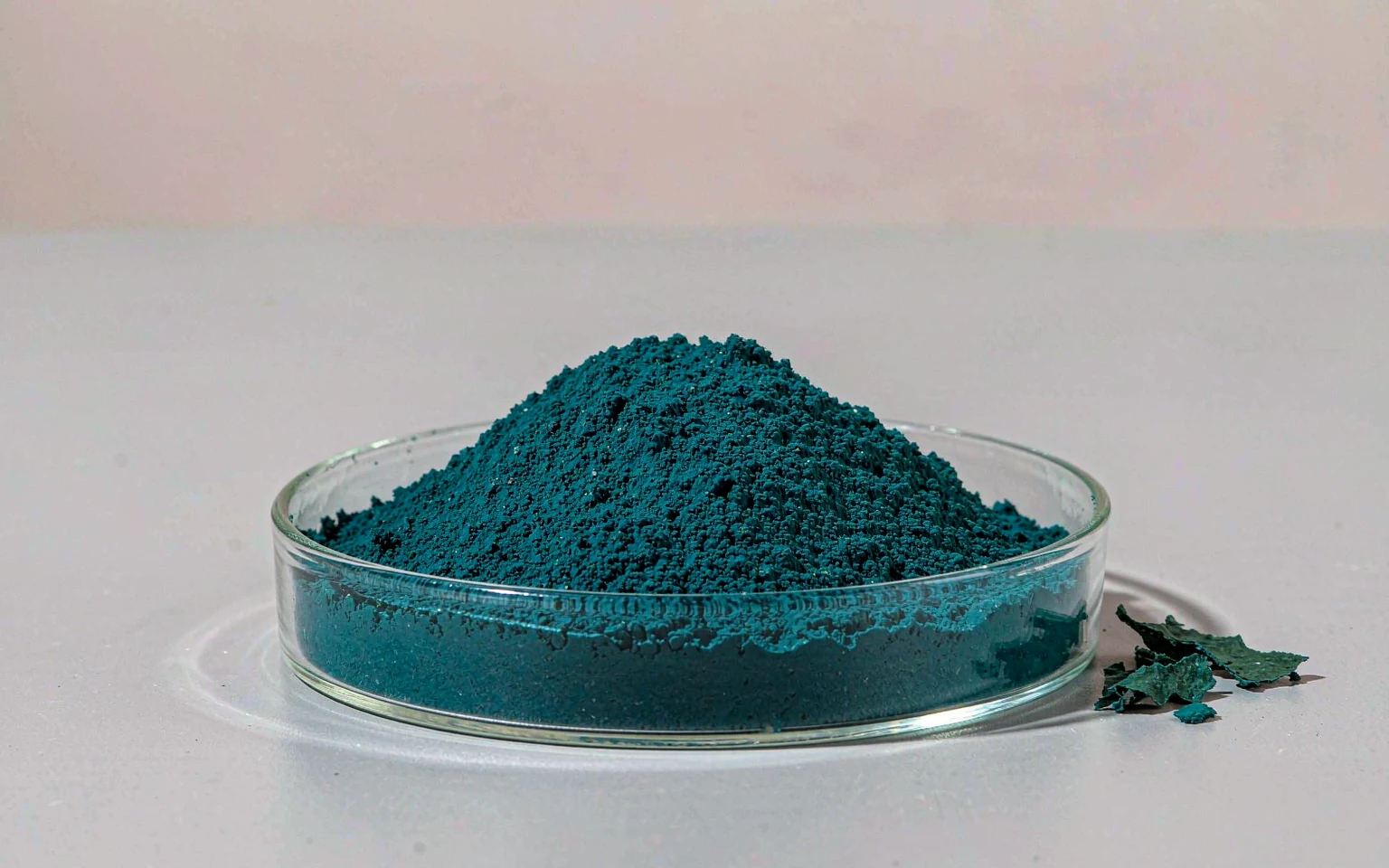
Spirulina concentrate is the only widely available natural route to a true blue in food, and it is also the grade where buyers most often receive the wrong material. A dried, milled whole-algae powder and a purified phycocyanin extract can both be sold as “spirulina colour”, but they are different products with different legal identities, different colour values and different behaviour in a formula. This page separates the two.
Regulatory Identity: Colouring Food, Not Additive
Spirulina sits on a boundary that is crossed by a single processing step. Dry the algae and mill it, and you have a food with a colour. Extract the phycocyanin out of it, and you have a colour additive. The two products look similar on a specification sheet and are not the same thing legally.
The ingredient route requires the source to be edible, the processing to be ordinary, and the enrichment to stay within what that processing can reach. Whole-algae material clears all three. The extract route fails the third by design, because concentrating toward the pigment is exactly what it does.
In the US there is no ingredient category for colouring, and spirulina is handled as a colour additive whichever route produced it. That is one more reason to establish the route from the written process description rather than from the product name, and to confirm status per market before formulation.
Product Specifications
| Item | Specification |
|---|---|
| Product name | Spirulina Concentrate |
| Colour value | To be confirmed |
| Appearance | To be confirmed |
| Carrier | To be confirmed |
| Solubility | Water-soluble |
| Standard | To be confirmed |
| Packaging | 1 kg bag for bench work, 25 kg drum for production |
| Shelf life | To be confirmed |
| MOQ | To be confirmed |
Fields marked To be confirmed are pending the supplier certificate of analysis for the grade you require. Colour value in particular should never be taken from a specification sheet without a batch record behind it.
Applications
- Hard candy and pan-coated products — the clearest blue in a natural palette, dosed into a low-moisture mass
- Frozen desserts — cold storage slows the degradation that ambient storage accelerates
- Dry beverage powders — dosed into a system with no free water, which is where this pigment is most comfortable
- Plant-based products where an algal ingredient is consistent with the positioning
Whole Algae or Extract: Where the Line Falls
This is the question that decides both the regulatory route and the formulation, and it is worth setting out side by side.
| Whole-algae concentrate | Phycocyanin extract | |
|---|---|---|
| EU identity | Colouring food where processing is drying and milling only | Colour additive — pigment selectively extracted |
| Composition | The whole algae: protein, lipids, minerals and pigment together | Purified phycocyanin, with the rest of the cell removed |
| Colour value | Lower — the pigment is diluted by everything else in the cell | Higher — the pigment has been concentrated |
| Behaviour in formula | Pigment behaviour is similar, but the algae solids add flavour, colour depth and buffering | Cleaner in dilute systems, with nothing else along for the ride |
The practical consequence is that the whole-algae grade asks more of the formulator. You get a food with a colour, not a colourant that happens to be natural, and the algae solids bring a seaweed note and a green cast that has to be worked with rather than ignored. In a strongly flavoured product that is manageable. In a delicate one it is not, and the extract is the correct choice despite the regulatory simplicity of the alternative.
Neither grade is a drop-in substitute for the other. Substituting without re-running the trial usually shows up first as a flavour problem and second as a shade problem, because the two materials do not deliver the same hue at the same dose.
Available Forms
Powder only. In whole-algae material colour value and flavour move together, so a lot with more pigment also carries more of the marine note — the specification has to hold both at once, which is why agreeing it against a sample matters more here than agreeing it against a number.
Why Green Spring
- The two grades kept genuinely apart. Concentrate and extract are distinct products with distinct paperwork, so the decision is made on the application rather than on availability.
- The identity question answered from the process. Where a lot sits on the ingredient-to-additive line is established from the written process description, not from the product page.
- Colour value and flavour specified together. In whole-algae material the two move in step, so both belong on the specification.
Frequently Asked Questions
What is the difference between spirulina concentrate and phycocyanin?
Phycocyanin is the blue pigment itself, extracted and purified from the algae. Spirulina concentrate is the algae, dried and milled, with the pigment still inside the cell along with protein, lipids and minerals. The extract has a higher colour value and a cleaner flavour; the concentrate keeps the whole-food identity and brings the algae’s own taste with it. In the EU they can also fall under different regulatory identities.
How does it behave in an acidic drink?
Phycocyanin is stable over a narrow window, broadly around pH 4 to 6, and colour loss accelerates as the pH drops below that. An acidic beverage at pH 3 is outside the comfortable range, and the result is usually a dulling or greying rather than an immediate failure. Where the product cannot be buffered into range, spirulina is normally the wrong pigment regardless of the grade.
Is the seaweed taste a problem?
In the whole-algae grade, yes, at higher doses — it is the reason the concentrate is better suited to strongly flavoured products. The note reads as marine rather than bitter, and it becomes more noticeable as the dose rises. In the extract grade the flavour load is much lower, which is one of the reasons formulators accept the higher cost.
How do I confirm the regulatory identity for my market?
Start from the process description, not the product name. In the EU, drying and milling alone keeps the material in the ingredient category; selective extraction moves it to the additive category. In the US the material is a colour additive either way, and the applicable entry depends on the source. Confirm per market and per grade before the formulation is finalised.
If you are choosing between the concentrate and the extract for a specific product, send us the application, the pH and the flavour constraints, and we will set out what each grade requires. Contact us, see the spirulina extract grade, or browse the full colouring foods range.