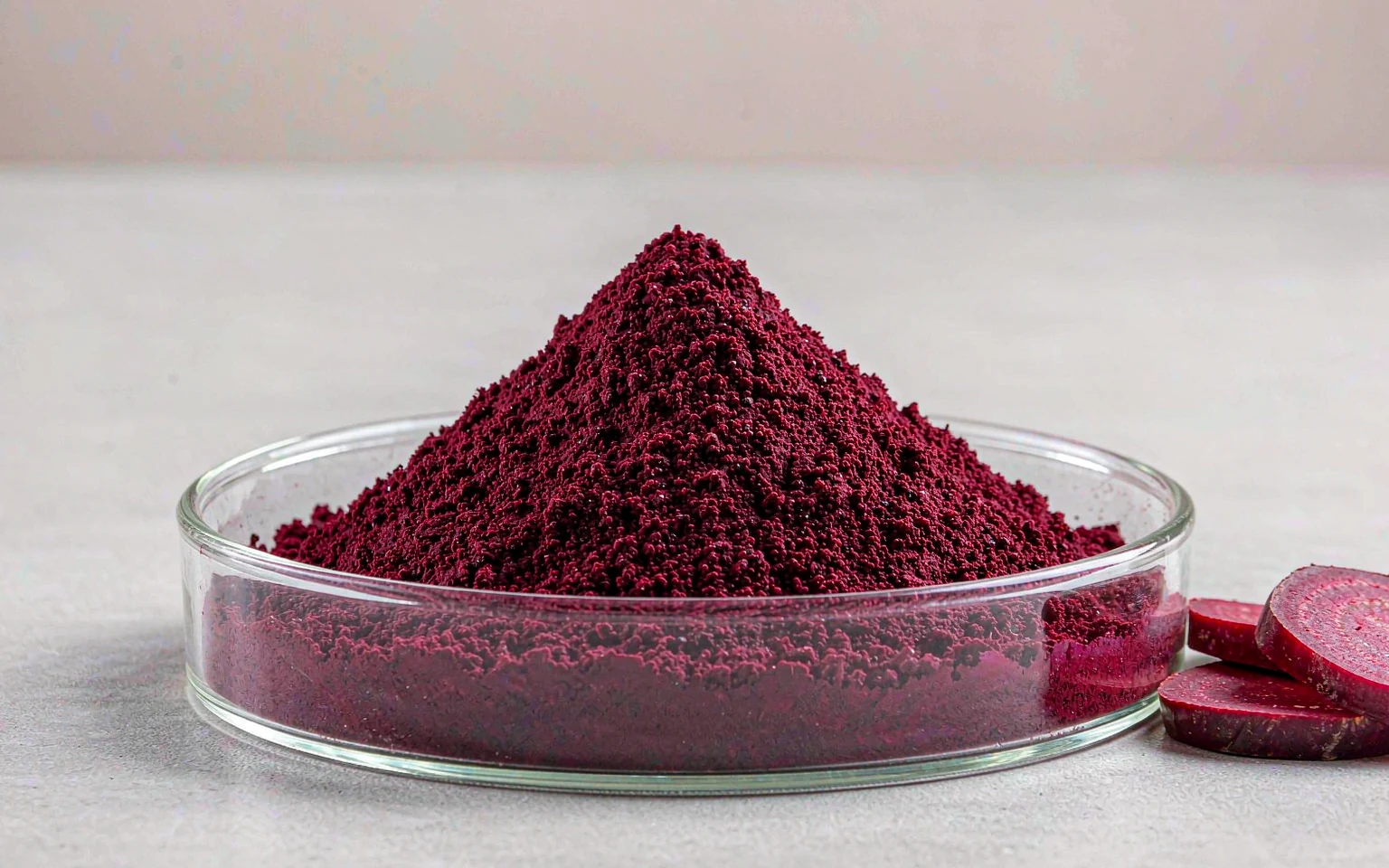
Beetroot juice concentrate is the material a formulator reaches for when the label needs to say beetroot rather than E 162. It delivers a clean pink to red in systems where the pigment is stable, and it fails in systems where heat is applied late and hard. This page covers the identity question, the heat constraint, and the part buyers usually get wrong: converting a colour value into a cost per unit of colour.
Regulatory Identity: Colouring Food, Not Additive
Two materials come out of one beet. Standardised beetroot red is the colour additive, carrying E 162 and a stated colour value. Beetroot juice concentrate is the juice, concentrated, declared by name with no number attached. Neither is a substitute for the other, and the choice between them is a formulation decision rather than a purchasing one.
What separates them is not intent but process. An edible source, ordinary processing, and no enrichment beyond what that processing can reach — where all three hold, the material is an ingredient. Beetroot satisfies the first without argument; the second and third depend on what the plant actually does, which is why the process description carries more weight here than the specification sheet.
The US does not have the ingredient category for colouring: the concentrate is regulated there as a colour additive from beet juice. So the same drum can be an ingredient in Europe and an additive in America, and status has to be confirmed per market before the label is signed off.
Product Specifications
| Item | Specification |
|---|---|
| Product name | Beetroot Juice Concentrate |
| Colour value | To be confirmed |
| Appearance | To be confirmed |
| Carrier | To be confirmed |
| Solubility | Water-soluble |
| Standard | To be confirmed |
| Packaging | 1 kg bag for bench work, 25 kg drum for production |
| Shelf life | To be confirmed |
| MOQ | To be confirmed |
Fields marked To be confirmed are pending the supplier certificate of analysis for the grade you require. We do not publish indicative colour values, because a figure not tied to a batch record invites a specification that the material cannot meet.
Applications
- Fermented dairy and yoghurt drinks — the pH window where the pigment holds red, processed with a mild heat step
- Frozen desserts — the cold chain does the protecting that the process cannot
- Sugar confectionery — deposited after the cook, so the pigment never sees the temperature
- Plant-based meat — where the beetroot name supports the ingredient story and the colour is a secondary benefit
Colour Value, Dose and What the Concentrate Actually Costs
Comparing a concentrate with a standardised colour additive on price per kilogram is the single most common purchasing error in this category. The two materials are not sold on the same basis, and the cheap-looking one is often the expensive one.
A standardised beetroot red preparation carries a stated colour value: the buyer knows how much colour a kilogram delivers, so cost per unit of colour is arithmetic. A concentrate carries the water and solids of the juice, so its colour value per kilogram is far lower — typically by an order of magnitude. You will use much more of it to reach the same shade.
The comparison only works when both are reduced to cost per unit of delivered colour. The method is the same either way:
- Establish the colour value of the concentrate as supplied, from the certificate, not from a brochure
- Calculate the weight of concentrate needed to match the colour intensity you currently get from the additive
- Price that weight, and add the cost of the extra solids, the extra freight and any flavour correction
- Compare that figure with the additive’s cost for the same delivered colour
Worked as an illustration only — the numbers below are hypothetical and meant to show the arithmetic, not a quotation: if an additive at colour value 100 costs one unit per kilogram, and a concentrate at colour value 10 costs one fifteenth of that per kilogram, the concentrate looks far cheaper per kilo. But you need ten times the weight, which puts the concentrate at roughly two thirds of the additive’s cost per unit of colour — before the additional freight on ten times the mass is counted. At that point the two are close, and the decision turns on the declaration rather than on the price.
The cases where a concentrate genuinely wins on cost are narrower than they look: products that need a large amount of colour anyway, where the solids are a functional part of the formula rather than an unwanted addition, and where the transport distance is short enough that the extra mass does not dominate.
Two Variables That Decide the Loss
Betanin degradation is not linear with temperature. Published stability work on beetroot preparations shows loss accelerating sharply above roughly 50 °C, which is why a 72 °C flash pasteurisation can cost less colour than a 65 °C hold of twenty minutes. The second variable is oxygen: dissolved oxygen in the mix drives oxidation, and deaeration before filling frequently recovers more colour than raising the dose.
Available Forms
The liquid keeps the beet’s sugars, and that decides more projects than colour does. At the dose a concentrate needs, the sugar contribution shows up in the nutrition declaration and in the taste, and neither is negotiable in a low-sugar product. Spray drying concentrates those solids per unit of colour, which shrinks the dose but does not remove the effect. Where neither is acceptable, the E 162 grade is the honest answer rather than a larger dose of concentrate.
Why Green Spring
- One root, two identities. The E 162 grade and the concentrate come from the same beet, so moving between the routes does not mean moving supplier.
- Colour value on the batch certificate. A concentrate cannot honestly be sold against a catalogue average, so the figure you receive is the figure for that lot.
- Heat-loss measured, not assumed. Give us your pasteurisation or UHT profile and we will set out what the colour is expected to do across it.
Frequently Asked Questions
How is this different from beetroot red?
Beetroot red arrives as a standardised preparation with a colour value printed on the certificate and E 162 in the EU declaration. The concentrate arrives as juice that has been boiled down, and its colour value moves with the crop. Dosing is the visible difference: grams against the additive, kilograms against the concentrate. Substituting one for the other without re-trialling is how projects lose a week.
What happens to the colour in a retort or UHT line?
Betanin degrades with heat, and the damage is a function of time and temperature together — a short blast at high temperature can do less harm than a long hold at a moderate one. Rather than quote a loss figure, we ask for your process profile and measure it. Adding after the heat step is the first option worth testing.
Will it change the sweetness or the nutrition panel?
It brings beet sugars with it. At the dose a pale shade needs, the effect is small enough to ignore; at a dose aimed at a strong pink it is not, and it lands in the sugar figure on the panel. That is a label question as much as a taste question, and it belongs in the trial rather than in the assumption.
Can I buy less than a drum?
To be confirmed. It depends on the form and on whether the grade is stocked or made to order. Give us the form and the monthly volume and the answer will be specific rather than a catalogue minimum.
If you are weighing the concentrate against the E 162 grade for a specific product, send us the application, the process step and the shade you need, and we will set out what each route requires. Contact us, or see the full colouring foods range.