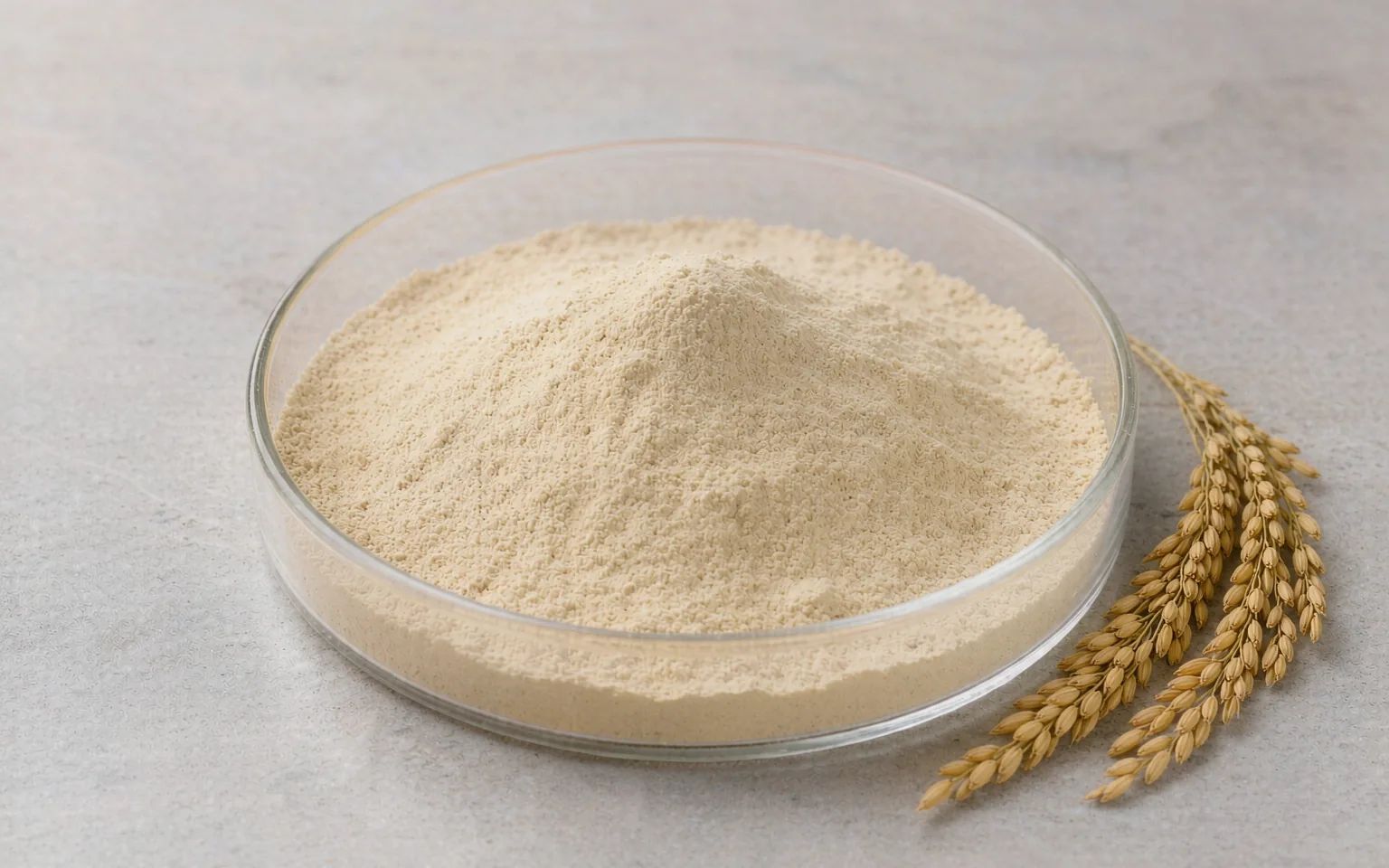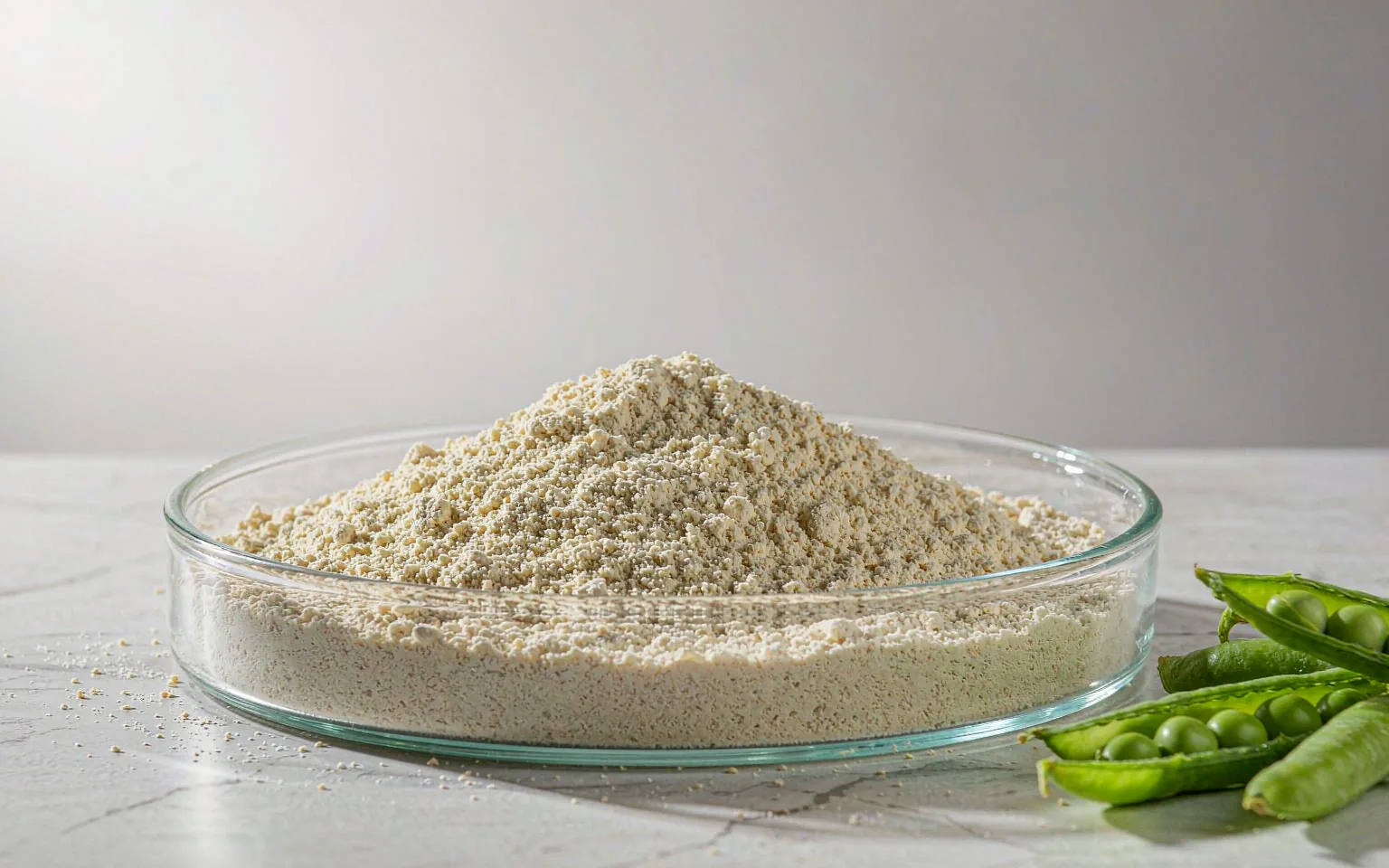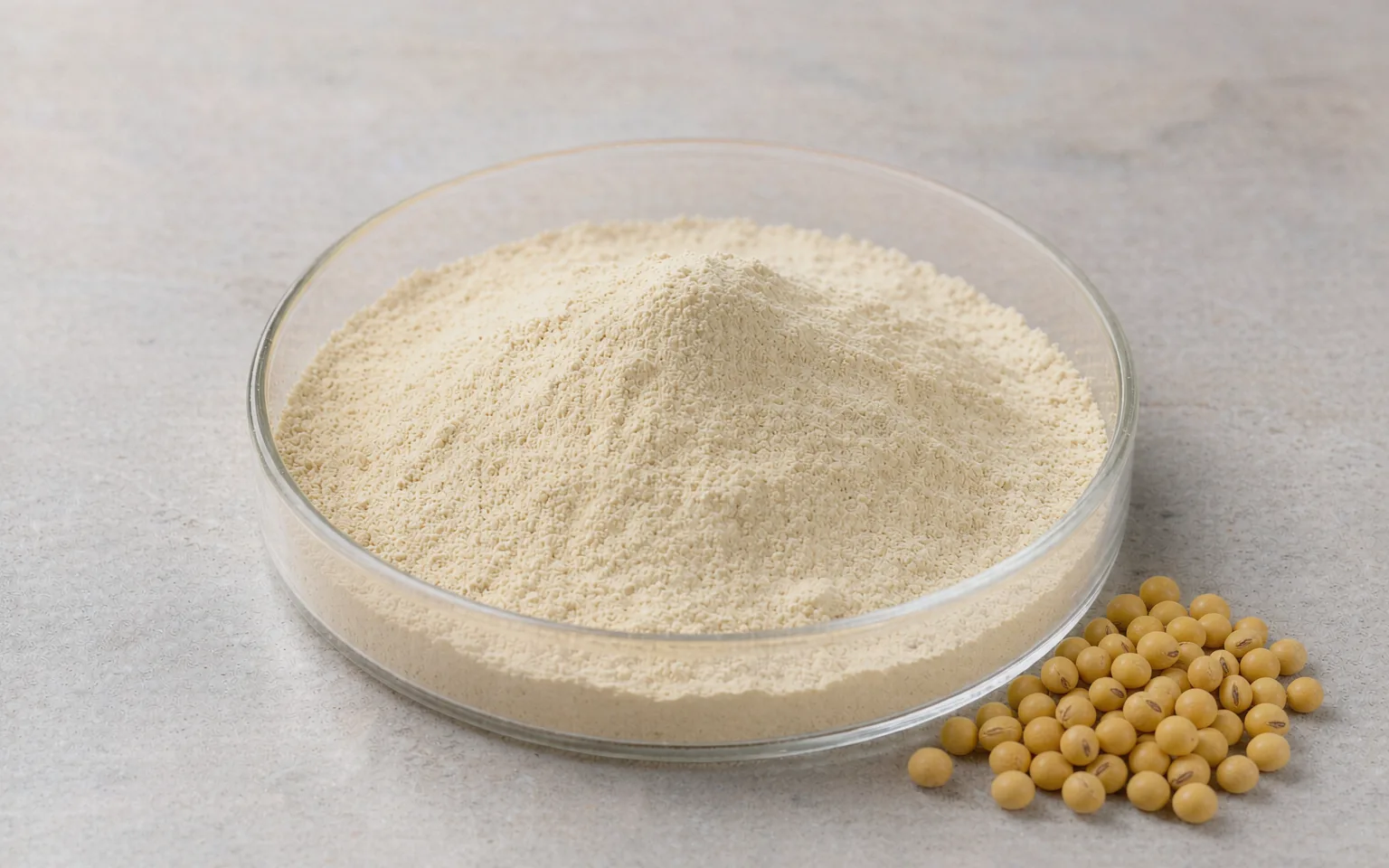
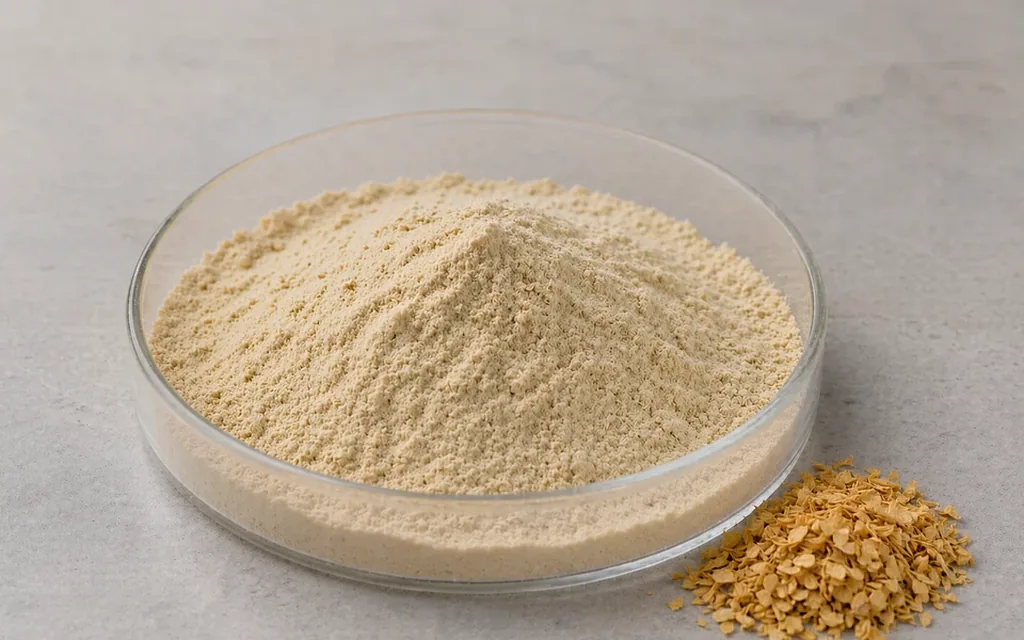
Yeast protein is the ingredient formulators reach for when the label has to say something other than pea or soy. It is a fermentation-grown protein from Saccharomyces cerevisiae, outside the major-eight allergen list, and outside the agricultural cycles that make seed proteins swing on price and availability. It carries a light savoury note with it, which is either a formulation asset or something to manage, depending on what you are building.
Green Spring manufactures yeast protein at 80% protein on a dry basis and supplies it in bulk to beverage, dairy-alternative, bakery and meat-analogue projects. Batch documentation is issued against the specification agreed with you rather than a catalogue sheet, and free samples are available for evaluation before you commit to a volume.
Why Buy Direct From the Manufacturer
Buying protein through a chain of traders adds cost and removes the two things that matter most in a reformulation project: control of the specification and a straight answer on batch data. Working with the producer changes what you are able to ask for.
- Specification agreed before the first order. Protein, moisture, ash and microbiology are set with you, and the certificate of analysis is issued against that agreed specification rather than a generic sheet.
- Samples and documents without a distributor in the middle. Sample requests, technical data and specification questions are answered by the people who control the process.
- One grade, specified properly. We manufacture a single 80% protein grade rather than a catalogue of variants, so the specification you agree and the material in every lot describe the same thing. If your project genuinely needs a different protein level we will say so, rather than stretch one grade to fit.
- Documentation that stands up in your compliance file. Specification sheet, per-batch certificate of analysis and safety data on request, so your quality and regulatory teams can review the ingredient properly.
Product Specifications
| Item | Specification |
|---|---|
| Product name | Yeast protein (Saccharomyces cerevisiae) |
| Protein (dry basis) | 80.0% min |
| Appearance | Pale yellow to yellow powder, uniform, no visible foreign matter |
| Moisture | 8.0% max |
| Total ash | 6.0% max |
| Nucleic acid (RNA, dry basis) | 2.0% max |
| Total plate count | 10,000 CFU/g max |
| Yeast and mould | 50 CFU/g max |
| Coliforms | Not detected (specification below 3.0 MPN/g) |
| Salmonella | Negative / 25 g |
| Staphylococcus aureus | Negative / 25 g |
| Lead | 0.5 mg/kg max |
| Cadmium | 1.0 mg/kg max |
| Mercury | 0.1 mg/kg max |
| Arsenic | 0.5 mg/kg max |
| Packaging | 25 kg net, food-grade inner liner |
| Shelf life | 24 months unopened, stored cool, dry and away from light |
These are the outer values our yeast protein is released against. Actual batch results are stated on the certificate of analysis shipped with each lot and are normally well inside these limits. The batch report, not this table, is the document your quality team should work from.
Why We Supply the 80% Grade
The yeast protein market carries a spread of grades and the names are not standardised: 48%, 70%, 75% and 80% all appear on commercial specification sheets, sometimes with a solubility figure attached. That spread exists because the process can be stopped at different points, and lower grades retain more of the yeast-derived fraction alongside the protein.
We manufacture and supply the 80% grade only. That is a deliberate position, and it has three consequences worth understanding before you compare suppliers:
| Point | What it means for your project |
|---|---|
| Protein density is fixed | Every lot delivers 80.0% minimum protein on a dry basis, so your formulation arithmetic does not have to be re-run against a moving protein figure. |
| The material behaves the same every time | Specification, batch behaviour and flavour contribution are consistent between lots, which is what de-risks a reformulation. |
| Lower grades are not offered | If cost per point of protein is the binding constraint, a lower grade from another supplier may suit you better, and we would rather tell you that than sell against it. |
One caution when comparing grades elsewhere: a grade name on its own tells you very little. Protein can be quoted on a dry basis or as-is, and the same material reads roughly six percentage points lower as-is at 8% moisture. A “75%” and an “80%” from two suppliers can describe the same powder on different bases, so ask for the basis in writing before treating two grades as genuinely different.
Amino Acid Profile
Published amino acid data for yeast protein alongside whey and soy protein and the FAO/WHO reference pattern. Values are milligrams of amino acid per gram of protein.
| Amino acid (mg/g protein) | Yeast protein | Whey protein | Soy protein | FAO/WHO pattern |
|---|---|---|---|---|
| Isoleucine | 57.4 | 50.7 | 42.9 | 30 |
| Leucine | 92.2 | 109.9 | 71.6 | 61 |
| Lysine | 94.8 | 97.8 | 61.8 | 48 |
| Sulphur amino acids (Met + Cys) | 34.9 | 36.9 | 26.3 | 23 |
| Aromatic amino acids (Phe + Tyr) | 98.8 | 75.3 | 83.2 | 41 |
| Threonine | 54.6 | 51.4 | 37.3 | 25 |
| Tryptophan | 10.4 | 19.5 | 14.8 | 6.6 |
| Valine | 51.1 | 49.8 | 44.0 | 40 |
| Histidine | 26.0 | 21.3 | 26.1 | 16 |
Source: Chen et al., “Amino acid composition and in vitro dynamic digestion of proteins from three different sources”, Journal of Henan University of Technology (Natural Science Edition), 2019. These are published reference values for yeast protein, not a batch release figure for the material we ship. Where yeast protein sits on protein quality scoring is a separate question from this table, because digestibility is measured independently of amino acid composition.
Applications
- Protein powders, bars and sports nutrition. The 80% grade keeps protein per gram of powder high while staying outside the major-eight allergen list, which matters wherever the label is allergen-constrained.
- Beverages and ready-to-drink systems. Our 80% grade disperses in water-based systems, where the practical constraint is the residual fat phase rather than the protein itself. Test clarity in your own matrix, because the fat fraction, not the protein content, is usually what decides whether a drink stays bright.
- Bakery and noodles. Used in bread and high-protein noodle formulations, where it raises protein content without disrupting the gluten network at moderate addition rates.
- Meat analogues and processed meat. The 80% grade contributes protein and binds at moderate addition rates, where its savoury note is an asset rather than something the flavour system has to mask.
- Dairy alternatives and frozen desserts. A neutral-to-light flavour base that does not read as beany, which is the complaint that pushes formulators away from legume protein.
What a Certificate of Analysis Actually Tells You
Most suppliers publish a specification sheet. Far fewer ship a batch-specific certificate of analysis, and fewer still will explain the numbers on it. The difference matters, because the same ingredient name can hide a ten-fold spread in limits.
Take cadmium. Two yeast protein specification sheets in circulation set the cadmium limit at 0.1 mg/kg and 1.0 mg/kg respectively, a ten-fold difference for a metal that accumulates. Neither figure is hidden; you simply have to compare the two documents side by side. Protein content behaves the same way. “80% min” on a specification sheet tells you only the floor, while the certificate of analysis shows what the batch actually assayed and whether that release test was run on a dry basis or as-is. For the full checklist of what a usable certificate must contain and which column carries the buying decision, see how to read a yeast protein certificate of analysis.
When a yeast protein certificate of analysis arrives, check four things before it goes into your file:
- The basis of the protein figure. Dry basis and as-is differ by the moisture content. A dry-basis figure of 80% is roughly 74% as-is at 8% moisture, and the two are not interchangeable in a formulation calculation.
- The test method. Kjeldahl nitrogen determination converts nitrogen to protein through a factor; both the method and the factor should be stated, particularly if you are comparing suppliers.
- Microbiology as results, not limits. A certificate that repeats the specification limit in the results column tells you nothing about the batch. Look for actual colony counts.
- Heavy metals one by one. Lead, cadmium, mercury and arsenic should each carry a separate result. A single “heavy metals: pass” line is not enough for a regulated market.
For scale, recent release data on an 80% grade has come in around 260 CFU/g total plate count against a 10,000 CFU/g limit, 3.75% moisture against an 8.0% limit and 2.36% ash against a 6.0% limit. The point is not that one batch is good; it is that the numbers are per batch and visible.
Regulatory status by market
Yeast protein is authorised in every market below, but the conclusion rests on the process rather than on the organism: Saccharomyces cerevisiae has a long history of food use, while an isolate produced by a particular enzymatic or membrane route may be a different regulatory article. That is why the strain and the process steps belong in the specification, not only in the brochure.
United States — GRAS, process-dependent
European Union — process-dependent
United Kingdom — process-dependent
Japan — food material
Indonesia, Malaysia, Vietnam and Thailand — food ingredient
Türkiye — novel food framework from 2026
Frequently Asked Questions
Is yeast protein the same as nutritional yeast or yeast extract?
No. Nutritional yeast is a toasted whole-cell condiment, yeast extract is an autolysed flavouring, and yeast protein is a protein concentrate built for fortification. Function, taste and labelling all differ – the protein figure on a nutritional yeast COA does not describe our product, and our product does not carry the yeast-extract glutamate discussion.
Is it gluten-free and allergen-free?
Saccharomyces cerevisiae is not among the major eight allergens. The yeast itself contains no gluten; we grow on molasses or glucose substrate and verify gluten below 20 mg/kg on every batch, which supports a gluten-free claim in the usual jurisdictions.
Why choose yeast protein over pea or soy?
Three reasons: the label (no allergen declaration), the supply (fermentation runs year-round, so no harvest-driven price swings), and the savoury character that lets formulators reduce added flavourings in meat-alternative systems. The trade-off is lower solubility than an isolate, which is why it is often blended rather than used alone.
Does it taste yeasty?
It carries a mild, savoury umami note rather than a bready or alcoholic one. At low single-digit usage rates most consumers read it as richness. If an application needs a more neutral base, tell us the target and we will discuss whether the 80% grade gets there in your matrix.
Is it suitable for vegan and clean-label positioning?
Yes – it is fungi-derived, fermentation-grown and non-animal, and the fermentation story tends to test well with consumers. One caution: native yeast protein is not a reliable vitamin B12 source, so if your claim needs B12 it should come from fortification, not the protein.
What protein content do you supply, and why only one grade?
We manufacture and supply the 80% grade only, on a dry basis. A single grade keeps specification, batch behaviour and flavour contribution consistent between lots, which is what matters when you are qualifying an ingredient for a reformulation. The wider market does carry lower grades (48%, 70% and 75% appear on specification sheets) and where a project is driven by cost per point of protein rather than density, one of those may fit better than ours.
What is the regulatory status of yeast protein in the United States and the European Union?
In the United States, baker's yeast protein is listed at 21 CFR 172.325 as a permitted direct food additive for nutrient supplementation, with no use-level limit. In the European Union, Saccharomyces cerevisiae has a documented history of consumption before 15 May 1997 at species level, but whether a specific protein isolate is a novel food under Regulation (EU) 2015/2283 depends on the production process and must be confirmed product by product through the Article 4 consultation procedure. Status should always be confirmed for your destination market and intended use.
Do you provide free samples?
Yes. Free samples of the 80% grade are available for evaluation. Tell us your application, target protein level and approximate monthly volume and we will send a sample together with the matching certificate of analysis.
This page covers the material itself. For the surrounding purchasing questions, the yeast protein buyer’s guide collects them into one sequence: reading the specification, regulatory status by market, and how the 80% grade compares with whey protein.
Free Samples and Documentation
Free samples of the 80% grade are available for evaluation. Tell us your application, your target protein level and your approximate monthly volume, and we will send a sample with the matching certificate of analysis. Specification sheets, batch certificates of analysis and safety data are provided on request, and specification adjustments are discussed before the first commercial order rather than after it.
Contact us to request a sample or to send us your specification.