
Two quotes for stevia extract can differ substantially because they may describe different glycoside profiles, purities or production routes. The difference is not markup. It is that the four commercial stevia extract grades — Reb A, Reb D, Reb M and total steviol glycosides — are different molecules with different yields, different sensory profiles, and in the EU, two of them sit under different food-additive entries entirely. A buyer who compares them on price per kilogram without knowing which grade is on the sheet is comparing nothing.
This guide covers what each grade actually is, where the cost difference comes from, how to read a certificate of analysis so the grade is verified rather than assumed, and which grade fits which matrix. It is written for buyers writing a purchase specification, not for a laboratory.
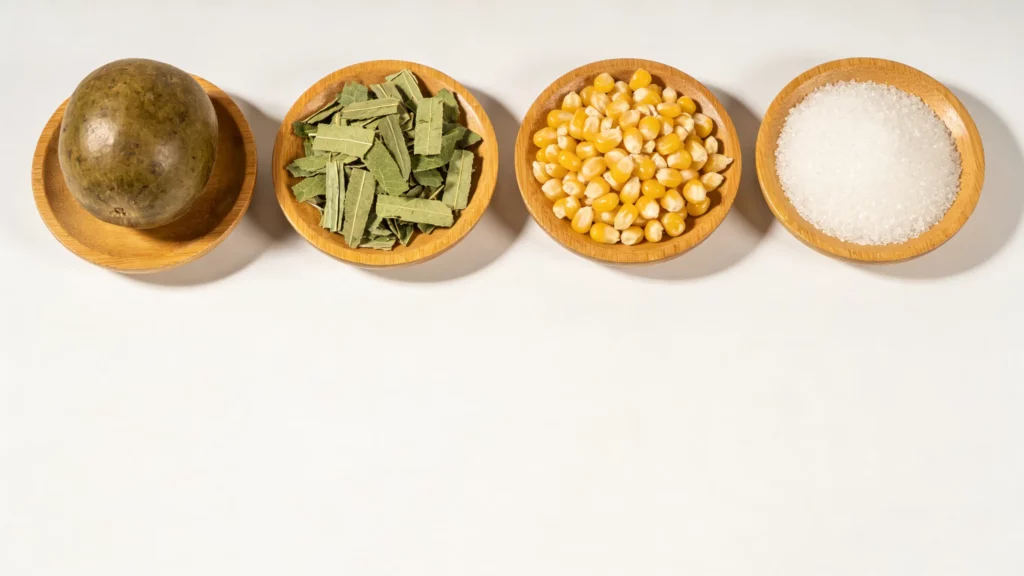
Steviol glycosides are a family of diterpene glycosides in the leaves of Stevia rebaudiana. They share a steviol backbone and differ in which sugar units are attached to it. That difference is small on paper and large in the mouth.
| Grade | Sweetness vs sucrose | Sensory character | Share of the leaf |
|---|---|---|---|
| Reb A (rebaudioside A) | 200–300× | Sweet with a bitter and liquorice tail that grows with dose | One of the two most abundant |
| Reb D (rebaudioside D) | 200–350× | Cleaner curve, markedly less bitterness than Reb A | Minor component |
| Reb M (rebaudioside M) | 200–350× | Closest to sucrose; least bitter and least lingering | Trace in the leaf |
| SG (total steviol glycosides) | 200–350× | Mixture — profile depends on the glycoside ratio | The extract as a whole |
The sweetness figures are quoted at a defined sucrose equivalence, usually in water; potency for any high-intensity sweetener shifts with concentration, so a number without a reference point is only indicative. Published sensory work puts Reb A, Reb D and Reb M at roughly 312, 318 and 341 times sucrose respectively in one controlled comparison, with bitterness and lingering sweetness falling in that same order.
SG is the odd one out on this table. It is not a single molecule but an extract defined by its total glycoside content — the specification requires not less than 95% of eleven named steviol glycosides in any combination and ratio. Two SG lots can both read 95% and taste completely different, because one may be mostly stevioside and the other mostly Reb A. That is the single most common source of "the last batch was better" complaints.
This is the part that buyers most often miss, and it decides what you are legally allowed to claim.
Reb A is extracted from the leaf, where it occurs in commercially useful quantities. Reb D and Reb M do not. Producing them at scale means either enzymatic conversion of purified steviol glycosides, or fermentation. The molecule that comes out is chemically the same, but the regulatory entry is not.
In the EU, Regulation (EU) 2021/1156 split the old E 960 into three entries:
| Entry | What it covers |
|---|---|
| E 960a | Steviol glycosides from Stevia — leaf extraction |
| E 960c | Enzymatically produced steviol glycosides, including Reb M made from steviol glycosides by enzyme modification |
| E 960d | Glucosylated steviol glycosides |
All three are authorised, and EFSA concluded the existing ADI of 4 mg/kg body weight per day, expressed as steviol equivalents, also covers enzymatically produced Reb M. But the label declaration differs, and that matters commercially in one specific way: material produced by fermentation using engineered yeast generally cannot carry a non-GMO or organic claim in most markets, however identical the molecule is. If clean-label positioning is part of your product's proposition, the production route has to be confirmed in writing before you commit volume — not inferred from the grade name.
In the US the picture is simpler on paper and harder in practice: steviol glycosides are permitted, with separate notifications covering Reb D, Reb M and enzymatically produced material. There is no E-number system, so the route shows up only if you ask for it.
Three factors, in order of weight:
Yield from the leaf. Reb A is abundant enough to be extracted economically. Reb M is present in the leaf only in traces, which is why a leaf-extraction route to Reb M is not commercially viable at scale. The cost of the molecule is largely the cost of getting it out of a plant that barely contains it.
The conversion step. Enzymatic bioconversion and fermentation both add capital, enzymes or media, purification and yield loss. Every one of those is a line item that Reb A does not carry.
Purity at the target glycoside. Getting total glycosides to 95% is routine. Getting a single named glycoside to a high percentage, with the secondary glycosides controlled, is where the cost sits — and where a cheap quote is usually explained.
Which is why the useful question is never "what is your price for stevia extract" but "what is your price for Reb M at this assay, produced by this route, with this glycoside profile".
Steviol glycosides are not fragile in the way some natural colours are, but they are not inert either. The published stability data is worth knowing before you set a process, because the degradation is pH-dependent and non-linear.
At ambient storage, material of 90–94% purity held at up to 24 °C in acidic solution at pH 2–4 is stable for at least 180 days. Raise the temperature and the picture changes: at 80 °C for 8 hours, roughly 4% decomposes at pH 4.0 and about 8% at pH 3.0. At 100 °C, those figures move to approximately 10% and 40% respectively. Steviol glycosides do not brown or caramelise when heated.
The practical reading is that a pasteurised or UHT beverage at moderate pH is comfortable territory, while a low-pH application held at retort temperatures deserves a stability statement specific to your process rather than a general reassurance. Ask for it against your actual time and temperature, not against a generic "heat stable" claim.
Reb M has an additional consideration in acidic systems: it is the grade most often chosen precisely because the base flavour cannot hide an off-note, so any degradation products matter more than they would in a heavily flavoured drink.
Five lines decide whether the certificate describes what you bought:
Heavy metals, pesticide residues and microbiology belong on every certificate regardless of grade, and for EU-bound goods the pesticide data has to clear EU MRLs rather than the origin market's. If a supplier sends a certificate with only a total glycoside figure and no profile, the certificate has not told you which grade you received.
| Application | Starting point | Why |
|---|---|---|
| Clear sparkling beverages, flavoured water | Reb M, or Reb A with a portion of Reb M | Nothing in the base hides an off-note, and the finish is what the consumer notices |
| Sports and energy drinks | Reb A | Acidity and flavour systems absorb the tail; cost matters at volume |
| Protein powders and RTD shakes | Reb M or Reb D | Protein bitterness and Reb A bitterness land on the same receptors |
| Dairy and dairy alternatives | Reb M or Reb D | Masks protein and botanical notes without adding masking agents |
| Bakery and batters | Reb A, or SG where a blend is acceptable | Bake flavours cover the tail; thermal stability is adequate across glycosides |
| Table-top and sachet blends | Reb A with erythritol or allulose | Bulk agent carries the mouthfeel; the sweetener only has to carry the sweetness |
Cost per kilogram is the wrong ranking criterion. The right one is cost per unit of sweetness delivered in your matrix, after the masking system and the bulk agent are accounted for.
Steviol glycosides have unusually broad acceptance for a high-intensity sweetener, which is one reason the category grew as fast as it did. The detail that varies by market is not whether they are permitted, but under which entry and with what documentation.
| Market | Status | What it means for your file |
|---|---|---|
| European Union | E 960a / E 960c / E 960d under Regulation (EC) No 1333/2008 | The entry must match the production route; declaration follows the entry, not the molecule |
| United States | permitted, with separate notifications covering Reb A, Reb D, Reb M and enzymatically produced material | No E-number system, so the route is documented only if you request it |
| JECFA / Codex | ADI 0–4 mg/kg body weight per day, expressed as steviol equivalents | The reference point most national frameworks align to |
| China | Permitted under GB 2760 | Domestic origin documentation is usually straightforward |
| Japan, Canada, Australia/New Zealand | Permitted under national novel food and additive frameworks | Each has its own specification wording; check per market |
Assess intended intake, permitted use levels, production-route identity and labeling together. The ADI is a population safety reference expressed as steviol equivalents; it is not a universal permitted dose for a finished food.
We supply all four grades — Reb A, Reb D, Reb M and total steviol glycosides — with the assay, glycoside profile and production route agreed against your specification before the first order rather than after. Where a project needs a specific named glycoside at a specific percentage, that is the first thing to settle, because it determines both the route and the price band.
What we need to quote accurately: the grade and assay you need, the production route your label requires, the matrix it goes into, and your approximate monthly volume. Samples with matching certificates of analysis are available for evaluation, and the specification sheet and safety data go out at quotation stage so your quality team can review the material before the purchase order.
For the regulatory detail behind the E-number split, see our note on natural sweeteners for bulk supply, and for the wider question of what "low glycemic" can and cannot claim, our guide to low glycemic index sweeteners.
Sweetness ranges, sensory descriptions and relative prices are illustrative rather than a product specification or current quotation. Request the assay/profile, production-route declaration and actual pricing for the selected stevia grade.
 Stevia ExtractReb A, Reb D, Reb M and total steviol glycoside grades, with the glycoside profile and…Read More »
 ErythritolThe bulking partner for high-intensity stevia grades: it restores the mouthfeel and body that a glycoside…Read More »
 AlluloseClosest to sucrose in behaviour, including browning, which is why it is blended with Reb A…Read More »
 Monk Fruit ExtractMogroside grades for projects that want a non-steviol route to high-intensity sweetness with a similar formulation…Read More »
Reb M and Reb D are both quoted at roughly 200 to 350 times sucrose, with Reb A at 200 to 300. In controlled sensory comparisons the three land close together on sweetness intensity; the practical difference is bitterness and lingering, which falls from Reb A to Reb D to Reb M. Choosing on the sweetness number alone misses that.
No. They are different molecules with different sugar units attached to the same steviol backbone. Reb A occurs in commercially useful quantities in the leaf; Reb M occurs only in traces, which is why it is normally produced by enzymatic conversion or fermentation rather than by extraction.
Three reasons. Reb M is present in the leaf only in traces, so a leaf-extraction route is not commercially viable at scale. The conversion step adds enzymes, purification and yield loss. And reaching a high assay at one named glycoside costs more than reaching 95% total glycosides.
No. Under Regulation (EU) 2021/1156, E 960a covers steviol glycosides from Stevia leaf and E 960c covers enzymatically produced steviol glycosides, including Reb M made by enzyme modification. Both are authorised and both sit under the same 4 mg/kg body weight ADI expressed as steviol equivalents, but the label declaration differs, and fermentation-derived material usually cannot carry a non-GMO or organic claim.
Total steviol glycosides on a dry basis with 95% as the floor, the individual glycoside profile by HPLC rather than only the total, the named glycoside assay for the grade ordered, the production route, and loss on drying together with mesh size.