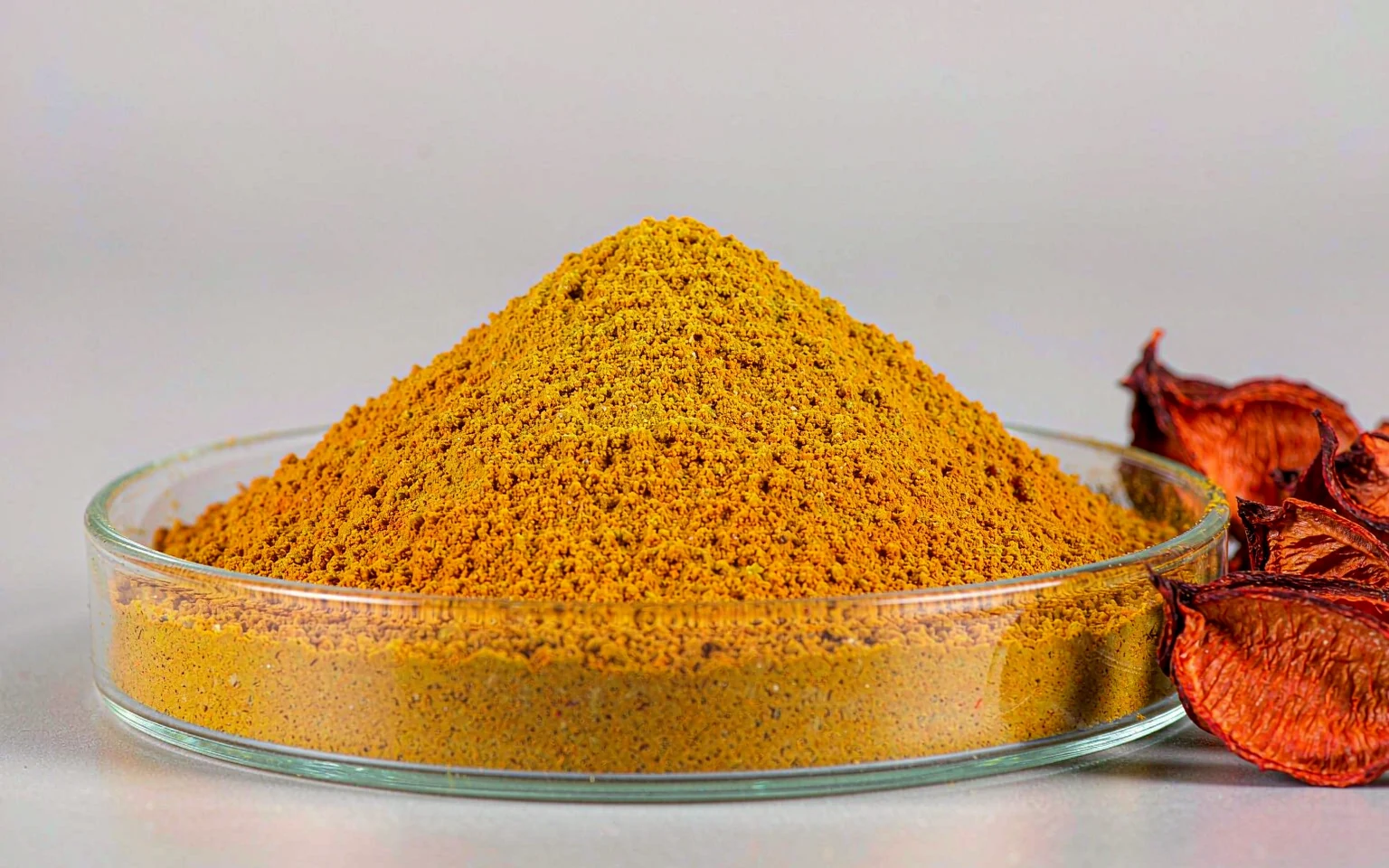
Safflower yellow concentrate occupies an unusual position: in the European Union it is available as a colouring food while the same pigment as a food additive has no authorisation at all. In the United States neither route is currently open. That combination makes this the clearest illustration of why the ingredient route exists — and the easiest page on the site to get wrong. What follows is limited to what can be confirmed from the regulations themselves.
Regulatory Identity: Colouring Food, Not Additive
Safflower is the clearest case in this range of a material whose legality depends on its legal identity rather than on its chemistry. As a food additive, carthamus yellow has no EU authorisation — the route is closed. As a colouring food, a concentrate of the petals is used in Europe. The pigment is the same; the category is not.
The ingredient route rests on three conditions: edible source, ordinary processing, and no enrichment beyond what that processing can reach. Those conditions describe what the material is, not what is convenient. Where they hold, the declaration is the ingredient name and there is no E number, because no additive authorisation is being relied on.
This is the EU legislature’s distinction between an ingredient and an additive, and it carries its own obligations under general food law. It is not a gap in the rules, and it should not be described as one. The US position is separate and closed, and China runs its own framework — status must be confirmed per market before use.
Product Specifications
| Item | Specification |
|---|---|
| Product name | Safflower Yellow Concentrate |
| Colour value | To be confirmed |
| Appearance | To be confirmed |
| Carrier | To be confirmed |
| Solubility | Water-soluble |
| Standard | To be confirmed |
| Packaging | 1 kg bag for bench work, 25 kg drum for production |
| Shelf life | To be confirmed |
| MOQ | To be confirmed |
Fields marked To be confirmed are pending the supplier certificate of analysis for the grade you require.
Applications
- Confectionery — where a golden to saffron yellow is required and the process heat is moderate
- Beverages — still drinks and concentrates in the yellow to amber range
- Bakery and snack coatings — applications tolerant of moderate light exposure in the pack
- Pickled and preserved products — where a warm yellow supports the expected appearance
Regulatory Status: One Material, Three Different Answers
This is the section that matters most for this product, because the answer to “can I use it” changes with the market and with the identity.
| Market | As a food additive | As a colouring food |
|---|---|---|
| European Union | Not authorised — carthamus yellow has no EU additive authorisation | Used as a colouring food concentrate |
| United States | Not approved as a colour additive | No equivalent category — the concept is not covered by US regulation |
| China | Permitted as a natural colour under GB 2760 | Relevant national framework applies |
Status differs by market and by regulatory identity. Confirm before formulation.
Three points deserve emphasis, because each is commonly misstated.
The EU additive position is “not authorised”, not “authorised under another number”. Carthamus yellow has no E number in the EU because it has no authorisation. Descriptions that attach an existing E number to safflower are incorrect — the numbers sometimes quoted belong to entirely different pigments.
The US position is “not approved”. A colour additive petition has been submitted by a supplier in the category, and the existence of a petition is a statement about an application, not about a status. A petition under review does not permit use, and it should not be presented to a customer as an approval in progress. Buyers who need to plan against a US launch should treat the current position as closed and re-check only when an official FDA listing appears.
China is a separate framework. GB 2760 permits safflower yellow as a natural colour, and that permission is not transferable to other markets. A Chinese supplier’s domestic authorisation says nothing about EU or US status.
The practical conclusion is the one this range exists to make: whether a material can be used depends on what identity it is sold under and where. The same concentrate is a legitimate ingredient in one market and has no route at all in another, and no amount of specification detail changes that.
Available Forms
This grade is supplied as a liquid concentrate and as a spray-dried powder. The liquid suits products where the water can be absorbed and the colour is dosed by weight; the powder suits dry blends and longer ambient storage. Colour value differs between forms and between lots, and should be confirmed against the batch certificate rather than assumed from the form.
Why Green Spring
- Closed markets stated as closed. Where the destination is the US, that is said at enquiry stage rather than discovered at label review.
- The ingredient route documented in writing. The EU position rests on the process, and the process description goes to your regulatory team for assessment.
- Colour value per lot. It matters more here than elsewhere, because the additive route may not exist as a fallback in your market.
Frequently Asked Questions
Why can safflower be sold in the EU but not in the US?
Because the two systems ask different questions. In the EU, an additive needs an authorisation and safflower yellow has none; but a concentrate of an edible plant processed by ordinary means can be sold as a food ingredient, which is the route used in Europe. The US has no equivalent ingredient category for colouring, so the material is assessed as a colour additive — and there is no approval for it. The material is the same; the legal framework is not.
How should I read news about a colour additive petition?
As an application, not an approval. A petition shows that a company has asked the FDA to assess a use; it does not authorise anything while it is under review, and there is no reliable way to predict the outcome or the timing from outside the process. For planning purposes, treat the US position as unchanged until an official listing appears.
How does the tone differ from turmeric?
Safflower reads as a cleaner golden to saffron yellow, without the earthy, slightly green cast that turmeric carries from its own pigments. In a product where the yellow has to sit beside fruit notes, that difference is usually the deciding factor. Turmeric also has its own regulatory position in each market, so the two are not interchangeable on compliance grounds either.
How light-stable is it?
Moderate. It holds better than anthocyanins under light but is not in the same class as the more robust synthetic yellows, and prolonged exposure in clear packaging will show. Where the pack is transparent and the shelf life is long, the light exposure belongs in the stability trial rather than in an assumption.
If you are assessing safflower for a specific market, tell us the destination and the application and we will set out which identity, if any, is available there. Contact us, compare with the turmeric yellow grade, or browse the full colouring foods range.