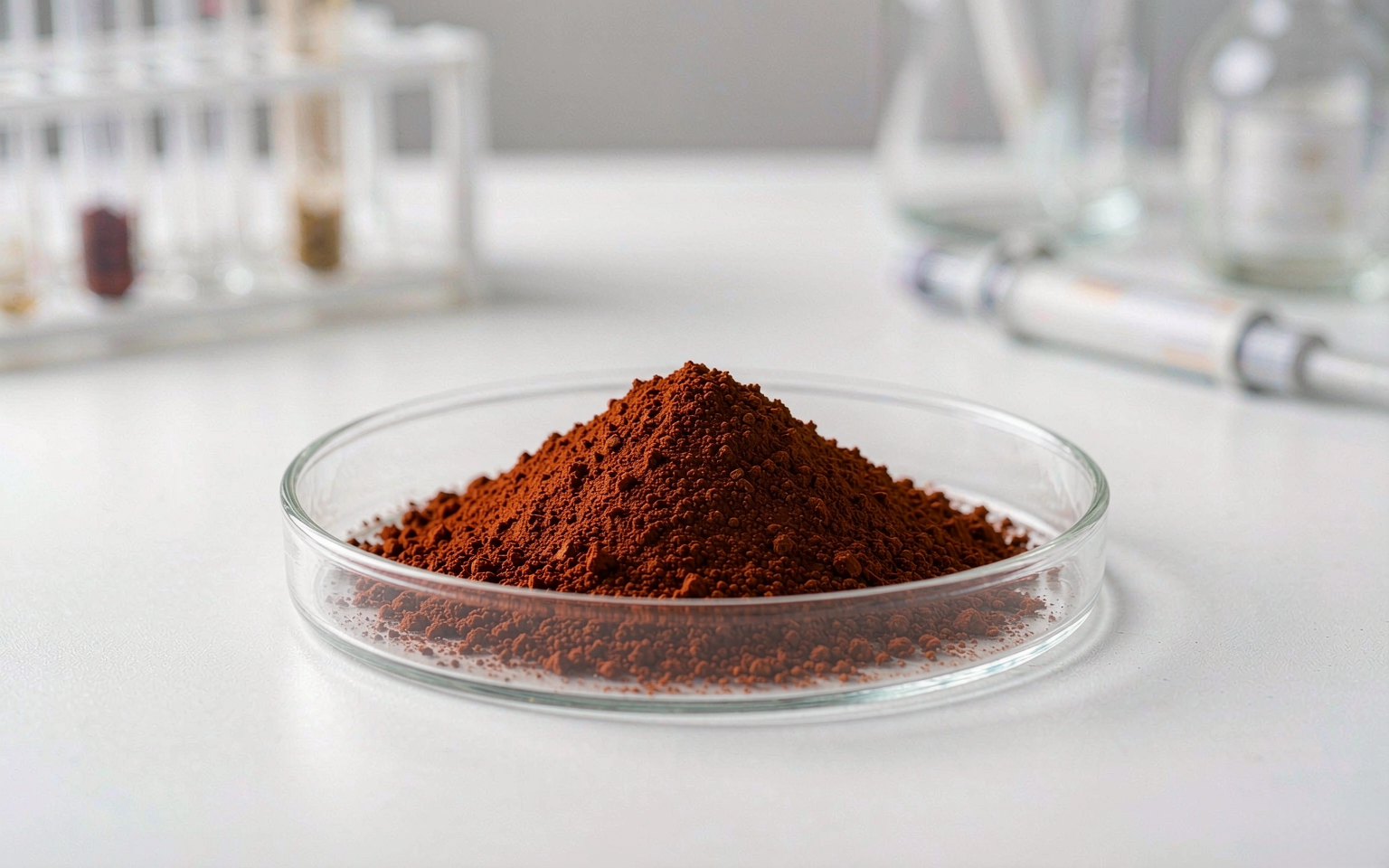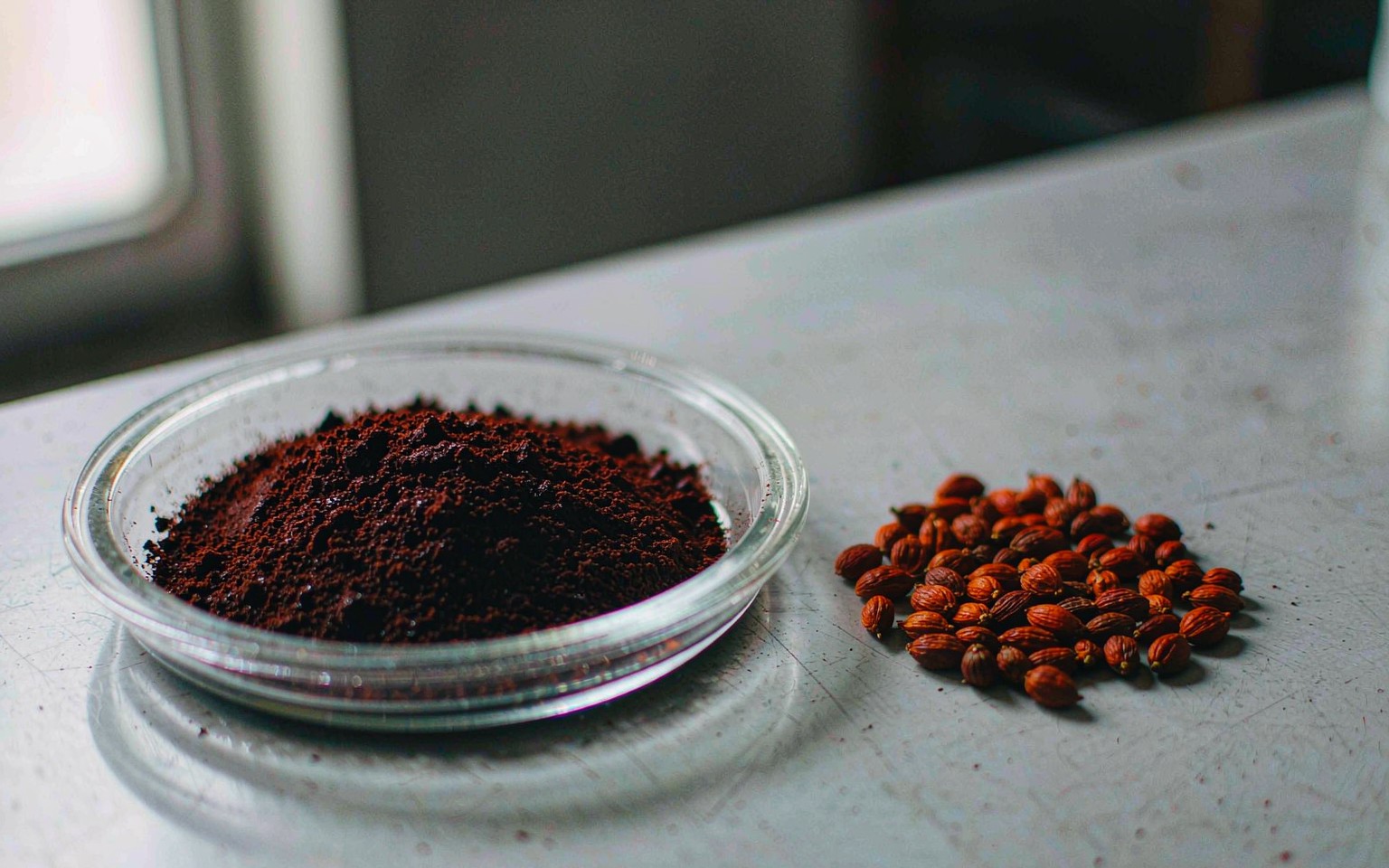

A natural food color certificate of analysis is usually read for one number: the assay. The buyer checks that it clears the specification, files the PDF, and moves on to price. That single number is also the most common reason two quotes that looked comparable turn out not to be, because the figure on the certificate is often not the figure that decides how much colour you actually receive per kilogram.
This guide is about reading that document properly: which lines carry the real information, how colour value and assay differ, why the carrier form changes the basis of the number before you compare anything, and what a certificate cannot tell you at all. It is written for buyers comparing grades across suppliers, not for a laboratory audience.
Lot traceability, microbiology, heavy metals and moisture are the same requirements that apply to any food ingredient, and our note on reading a certificate of analysis covers them line by line. Three things are specific to a colour and decide whether two offers can be compared at all: the regulatory identity of the grade — the E number under Regulation (EC) No 1333/2008 in the European Union, or the listing in 21 CFR Part 73 for colours exempt from certification in the United States — the carrier form, and the basis on which the colour value was measured.
Colour value — also called colour strength, tinctorial strength or colouring power — is a spectrophotometric measurement. A defined weight of the colour is dissolved or dispersed in a defined solvent, diluted to a stated concentration, and read at a stated wavelength in a 1 cm cell. The result is commonly expressed as the absorbance of a 1% solution, written E1% 1cm, or normalised to a round figure such as 100 or 150 so that grades can be traded against a reference.
What matters commercially is that colour value is the denominator of your real cost. Price per kilogram alone cannot rank two suppliers, because the kilogram is not the unit you buy. The unit you buy is colour.
| Supplier | Price per kg | Colour value | Cost per colour unit |
|---|---|---|---|
| A | USD 100 | 100 | 1.00 |
| B | USD 140 | 160 | 0.875 |
Supplier B is 40% more expensive per kilogram and about 12% cheaper per unit of colour. Divide price by colour value, and the comparison becomes arithmetic instead of impression. The one condition is that both figures must sit on the same basis — same solvent, same wavelength, same concentration convention. A colour value measured in water and a colour value measured in oil are two different measurements that happen to share a name.
Colour value is not a universal unit. Each family of pigments absorbs light in its own band, so the measurement is defined family by family, and a figure from one family cannot be set against a figure from another — only against another lot of the same pigment, measured the same way.
Carotenoids such as beta-carotene and lycopene absorb in the blue-violet region, roughly 450 to 470 nanometres, which is why their solutions read as orange and red. Betalains from beetroot peak near 535 nanometres, in the green band. Anthocyanins sit around 520 nanometres and shift with pH, so their measurement has to name the buffer as well as the solvent — a single anthocyanin figure with no pH attached is close to meaningless. Chlorophyll and its copper complexes are read toward the red end of the spectrum, at longer wavelengths again.
The consequence for procurement is that wavelength and solvent are not footnotes on a certificate. They define the unit being quoted. Two suppliers offering "colour value 100" for different pigment families, or for the same family read at different wavelengths, are not offering the same thing, and no amount of arithmetic will reconcile the two figures.
| Pigment family | Examples | Where it is read | What the certificate must add |
|---|---|---|---|
| Carotenoids | Beta-carotene, lycopene, annatto bixin | Blue-violet band, roughly 450–470 nm | The solvent, and whether the grade is a dispersion or a beadlet |
| Betalains | Beetroot red, betanin | Green band, near 535 nm | The pH of the dilution, since betanin shifts with it |
| Anthocyanins | Black carrot, grape, elderberry preparations | Near 520 nm, strongly pH-dependent | The buffer used and the reference standard applied |
| Chlorophylls | Copper chlorophyllin | Red end, longer wavelengths | Whether the copper complex is the specified form |
Assay measures how much of a named chemical is present. Colour value measures how strongly the material colours something under defined conditions. For a colour, the two move together but they are not interchangeable, and the gap between them is where purchase disputes come from.
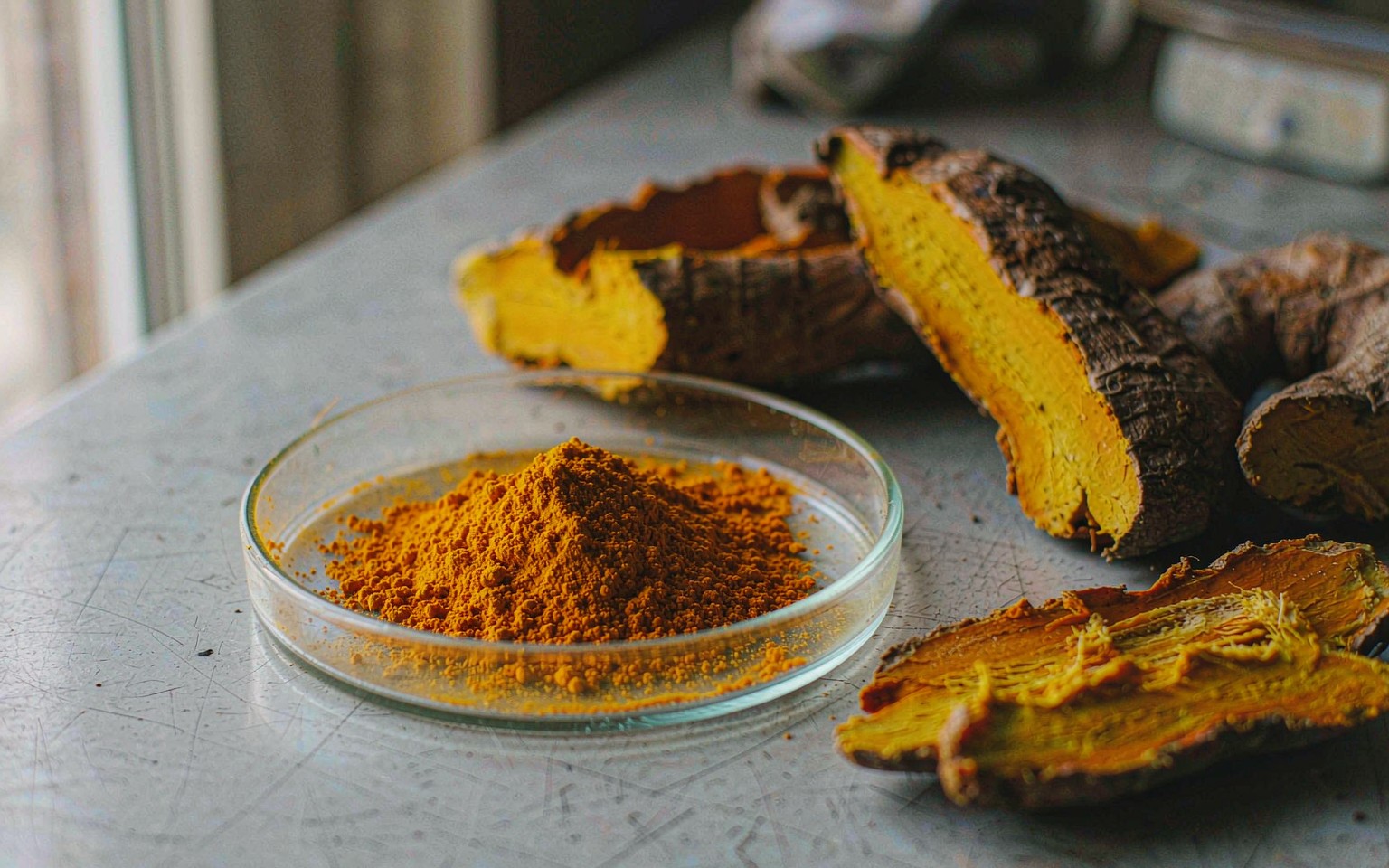
Turmeric-derived colour is the clearest case. An extract can be sold on total curcuminoids by HPLC — the sum of curcumin, demethoxycurcumin and bisdemethoxycurcumin — while the colour value is a separate spectrophotometric figure. A grade described as 95% curcuminoids is not the same material as one described as 95% curcumin, because the first is a sum of three related compounds and the second is one of them. Both statements can be true, accurate and commercially misleading at the same time. Ask which figure the price is built on, and ask for both on the certificate.
Colour value tells you how much colour a kilogram delivers. It says nothing about which colour. Two lots can both read 100 on strength and still look different in the same application, because strength and shade are measured on separate scales and a certificate usually reports only the first.
Shade is described in CIELAB coordinates: L* for lightness, a* and b* for the red-green and yellow-blue axes, measured under a stated illuminant and observer. The straight-line distance between two measurements in that space is ΔE, and most colour-matching protocols treat a difference of about one unit as the threshold of a just-noticeable difference. Hue angle and chroma are derived from the same coordinates and are the two figures a formulator usually asks for when a shade has to sit next to an existing product on a shelf.
There is a second complication: the instrument configuration has to match the system you are colouring. A translucent beverage or a clear gel is read in transmission, while an opaque icing, a panned shell or a compressed tablet is read in reflectance, and the two geometries do not return the same coordinates for the same pigment. Comparing a transmission measurement against a reflectance measurement is the shade equivalent of comparing a colour value in water against one in oil.
This is where a certificate quietly runs out of information. Instrumental shade data is rarely printed on a standard certificate of analysis, because the document is written to prove the lot met a specification rather than to support a shade match. If your application is shade-critical — a confectionery panned shell, a beverage that has to hold a reference against last year's pack — ask for L*a*b* values and the ΔE against your reference, measured on the same instrument and illuminant. A supplier who cannot produce them is selling colour as a commodity, and the difference will show up on your line rather than in the paperwork.
Most natural colours are not sold as pure pigment. They are sold on a carrier, diluted to a standard strength, or converted into a water-dispersible form. That processing step is legitimate and often necessary, but it changes the basis of every number on the certificate.
Annatto is the textbook example. The seed coat carries bixin, which is oil-soluble; alkaline hydrolysis converts it to norbixin, which is water-soluble. The two are sold under the same colour name, measured in different solvents, and used in different applications — one for fat-based systems, one for aqueous ones. A certificate that says "annatto extract" without naming which form, and in which solvent the colour value was measured, cannot be compared with anything.
Carrier chemistry is where the numbers diverge furthest. A spray-dried preparation built on maltodextrin or gum arabic, an emulsified oil dispersion stabilised with an emulsifier, and a beadlet with an encapsulation matrix can all be sold at the same nominal pigment load while delivering different colour per kilogram, because the carrier occupies mass that the certificate counts but your batch does not colour with. Ask what the pigment load is on the preparation, not only what the preparation contains.
The same trap appears across the category. A beta-carotene beadlet at 1% or 10% in a starch matrix, a 30% oil suspension, and a crystalline material are all "beta-carotene", and their colour values are not on a common basis. A lycopene powder dispersed in oil and a water-dispersible lycopene powder behave differently in a beverage and are tested differently. The label percentage tells you the concentration of the preparation; it does not tell you the colour delivered per kilogram.
| Figure | What it measures | Typical method | What goes wrong if you read it as something else |
|---|---|---|---|
| Colour value | Colouring strength under defined conditions | Spectrophotometry at a stated wavelength and solvent | Compared across solvents, it produces a false ranking of suppliers |
| Assay | Content of a named compound or compound group | HPLC, often with a reference standard | Treated as colour strength, it overstates how much colour the lot delivers |
| Loss on drying | Residual moisture and volatiles | Oven or vacuum drying to constant weight | Ignored, it predicts caking in store and colour drift in the finished product |
Loss on drying deserves its own line on your purchase specification rather than a glance. Moisture is not an inert passenger in a powder colour: it drives agglomeration in the bag, it can shift the measured colour value between the release test and the day you open the drum, and in a water-dispersible grade it is the difference between a powder that wets out cleanly and one that forms lumps on the surface of your batch.
Nothing on a certificate describes how the colour behaves in your product. Your application has its own pH, its own heat history, its own light exposure and its own shelf life, and colour is one of the few ingredients that fails visibly — the customer sees the fade before anyone reads a specification.
So treat the certificate as the entry ticket, not the decision. Three questions belong in the enquiry rather than the file: what pH range has this grade been tested across; what heat process has it survived, and for how long; and what light exposure and storage condition is it packed for. Suppliers who work with formulators will answer with data. Suppliers who trade material will answer with adjectives. If you want to see how much this matters for one colour family, the note on natural blue pigments in food walks through how quickly anthocyanin-type and gardenia-derived blues diverge once pH and heat enter the picture.
Cost per colour unit is still a laboratory-to-warehouse comparison. Four more lines decide what the material actually costs once it reaches you, and they can reverse a ranking that looked settled on paper.
Freight and packing. Colour arrives in fibre drums on a pallet, and freight is quoted on both weight and volume. A standardised preparation carrying a carrier is bulkier per unit of colour than a concentrated one, so the cheaper-per-kilogram option sometimes ships more air. Ask for the drum net weight, the drums per pallet and the pallet dimensions before you compare quotes.
Price breaks. Colour is usually quoted in tiers that step down with quantity, and the step is often large between a sample order and a pallet. Compare the tier you will actually order at, not the headline figure, and check whether the tier boundary sits just above or just below your annual volume.
Stock position and lead time. A grade held in a regional warehouse can be delivered in days; a grade shipped from origin adds a transit and an import cycle. If your production plan is monthly, that difference in lead time is worth more than a few percent on the invoice, because it decides how much safety stock you carry.
Terms and currency. Payment terms, the incoterm the quote is built on, and the currency the price is fixed in all belong in the comparison. A quote built on one incoterm compared against another is not a comparison at all.
Work down five lines, in this order:
If both pass, the decision has left the paperwork. It is about performance in your matrix, the documents your market requires, and whether the supplier can hold the same basis on the next lot.
We issue a certificate of analysis per lot for every colour we supply, with the method, the release limit and the measured result on the same page, and we will send the certificate of a current lot with the quotation rather than after the order. The natural colors range covers annatto, curcumin, lycopene, beta-carotene and the rest of the palette, each with a specification sheet that states the basis of the colour value.
If you are comparing two grades, send both certificates and the application — pH, process temperature, and the shade you are matching — and we will tell you which of the two figures actually governs your case. Free samples of annatto extract, curcumin extract and lycopene are available for bench trials. Request a quote or a sample.
 Annatto ExtractOil-soluble bixin and water-soluble norbixin are sold under one colour name and measured on different bases…Read More »
 Curcumin ExtractA colour where the HPLC curcuminoid assay and the spectrophotometric colour value are routinely confused, and…Read More »
 LycopeneSupplied as an oil dispersion rather than a plain powder, so the carrier form decides both…Read More »
The product name with its regulatory identity, the lot number, manufacture and expiry dates, the net quantity, and each parameter with its test method, release limit and measured result. Microbiological and heavy metals panels belong on the same document, and it must name the manufacturer and carry a signature or stamp.
Because the kilogram is not the unit you buy. Dividing price per kilogram by colour value gives cost per colour unit, which is what actually reaches your batch. A more expensive kilogram at a higher colour value can be the cheaper material, provided both figures were measured in the same solvent at the same wavelength.
Not directly. The two forms are measured in different solvents, so the colour value figures are not on a common basis, and they are used in different applications. Compare oil-soluble with oil-soluble and water-dispersible with water-dispersible, then compare the pairs on cost per colour unit.
No. A certificate describes the material as released, in the solvent the laboratory used. Stability depends on your pH, heat process, light exposure and shelf life, so it has to be tested in your matrix. Ask for application data and run a bench trial before the production order.