
An 80% yeast protein specification sheet looks simple. There is one headline number, a column of limits, and a packaging line. In practice the headline number is the least informative figure on the page, because how it was measured and what it was measured against changes what it means by several percentage points.
What follows is a line-by-line reading of a yeast protein specification. The examples come from two 80% specifications currently in circulation, which is useful precisely because they do not agree with each other. Where they differ, the difference is the point.
"Protein 80%" means very little until you know the basis. On a dry basis, the figure describes the powder with all moisture removed. As-is, it describes the powder as it actually arrives at your plant. The two are linked by moisture content, and at a typical 8% moisture a dry-basis figure of 80.0% works out to roughly 73.6% as-is.
That is a swing of more than six percentage points on the same material. It matters the moment you cost a formulation per gram of delivered protein rather than per kilogram of powder. The line to look for on any specification is therefore not "protein: 80%" but "protein (dry basis): 80% min" or "protein (as-is): 80% min". If the basis is not stated, the number is not usable in a formulation calculation.
The second question is how the laboratory arrived at the figure. Nitrogen determination by the Kjeldahl method converts measured nitrogen into protein using a factor, and the convention for yeast protein is 6.25. Laboratories applying a different factor to the same sample will report a different protein figure without either being wrong by its own reference method. When you compare two suppliers, compare the method before the number.
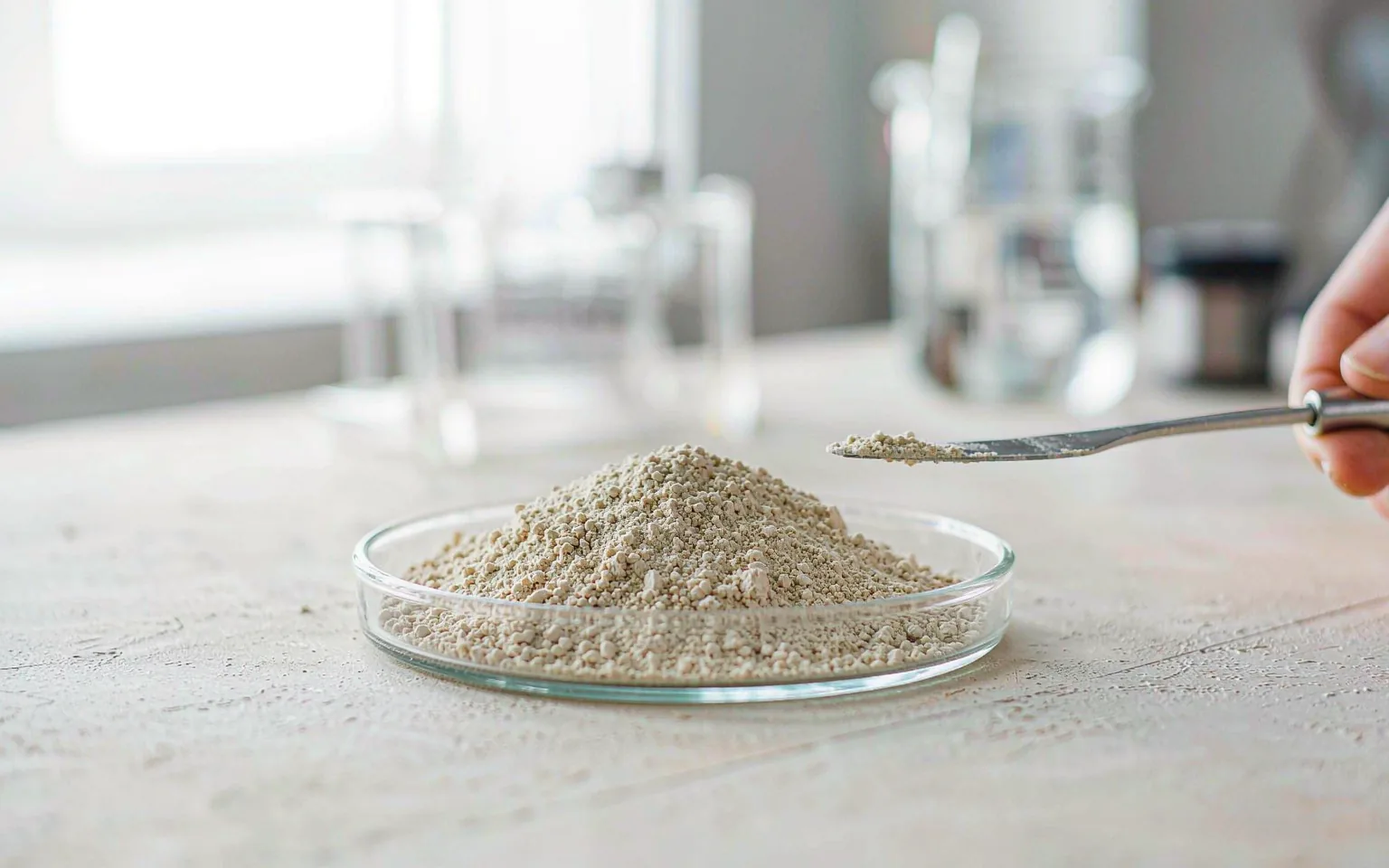
Moisture and ash are the two lines most often skimmed over, and both tell you something about the material that the protein figure hides.
Moisture sets how much of the delivered kilogram is water. It also feeds directly into the dry-basis calculation above, so a specification with a loose moisture limit is a specification whose delivered protein content can drift between shipments without any change to the process. One of the two 80% specifications in circulation allows moisture up to 8.0%; the other caps it at 6.0%. Both can be met by the same supplier on a good day, which is exactly why the tighter figure is the more useful control.
Ash is the mineral residue left after incineration. In a yeast protein it reflects the salts and minerals carried through from the fermentation medium and the downstream process. A limit of 6.0% is a fairly loose ceiling; a released batch that comes in at 2.36% is telling you the process is well controlled, because the material is running far below what it is permitted to be.
Together with fat and carbohydrate, moisture and ash account for everything the protein figure leaves out. That remainder is not filler, and one part of it deserves particular attention in beverages.
The nutritional panel on a yeast protein specification is not decoration. A representative 80% grade carries around 10 g of fat per 100 g of powder, of which about 0.9 g is saturated. That is a substantial fat load for an ingredient being asked to disperse in water.
Fat is the practical reason a high-protein clear beverage is difficult to formulate with yeast protein, and it is why the solubility figures on a specification are only half the story. A grade described as "solubility above 40%" has been processed to disperse more readily, but the residual fat phase still has to be managed, whether by homogenisation, by an emulsifier system or by accepting an opaque product. Protein solubility and system stability are two different problems, and a specification sheet only reports the first. The second is set by the formula, and protein solubility in acidic beverages is where to start.
The other items on the panel are worth a glance too. Carbohydrate sits low, around 3.7 g per 100 g, and sugar is typically reported as zero. Sodium around 370 mg per 100 g is not trivial and belongs in the salt calculation for any savoury application.
RNA, or nucleic acid, is capped on yeast protein specifications at 2.0% on a dry basis. This is one of the more unusual lines on the sheet, and it is there for a reason.
Yeast is naturally high in nucleic acid. The fermentation and purification route is designed to bring it down, and the specification limit is the evidence that it has been brought down. It matters commercially because nucleic acid is the precursor pool for purines, and purine intake is a consideration for a specific group of consumers with gout or raised uric acid. That makes RNA the one line on a yeast protein specification that speaks to who can eat the product, not just how well it performs.
Two cautions belong here. First, a specification limit is a ceiling, not a measurement; the released figure on the batch certificate is what you should use. Second, this is a compositional parameter, not a health claim in either direction. If a finished product needs a statement about purine content, that is a separate piece of work with its own regulatory footing.
Microbiology is where a specification is most often copied from a template rather than written for the material, and it shows.
The block normally covers a total plate count, coliforms, yeast and mould, and two pathogens: Salmonella and Staphylococcus aureus, both on a per-25-gram basis and both specified as absent.
Yeast and mould deserves the closest reading of the group, because the material is itself a yeast. A specification that sets yeast and mould at 50 CFU/g is drawing a line that recognises what the ingredient is. A specification that omits the organism-specific count, or that reports a combined "yeast and mould" figure without a separate plate count, has not thought about the product.
Coliforms are usually specified as absent or below 3.0 MPN/g. Total plate count limits vary widely across specifications, from 5,000 to 10,000 CFU/g, and the gap between the limit and the released value is often large. A recent released batch of an 80% grade was assayed at 260 CFU/g against a 10,000 CFU/g ceiling, which is a comfortable margin; the margin, not the limit, is what tells you the process is under control.
Heavy metals are the clearest demonstration that "80% yeast protein" describes a family of materials, not a single one. Two specifications in circulation set the cadmium limit as follows.
| Metal | Specification one | Specification two |
|---|---|---|
| Cadmium | 0.1 mg/kg max | 1.0 mg/kg max |
| Lead | 0.35 mg/kg max | 0.5 mg/kg max |
| Mercury | 0.05 mg/kg max | 0.1 mg/kg max |
| Arsenic | 0.3 mg/kg max | 0.5 mg/kg max |
The cadmium figures differ by a factor of ten. That is not a rounding difference or a typographical variation; it is two different commercial positions on the same metal in the same ingredient category. Both are legal to sell. Neither is hidden. You simply have to put the two documents side by side to see it.
Since heavy metals accumulate in the body rather than clearing quickly, and since a protein ingredient can be used at high inclusion rates, the ceiling on the specification is the parameter worth negotiating. A supplier who cannot or will not tighten the cadmium limit is telling you something about either the raw material or the process.
Everything above is a limit. None of it is a measurement. A specification sheet is a statement of what the supplier is prepared to be held to; it is not evidence about any particular batch.
Three things follow. Batch-to-batch consistency cannot be read off a specification at all, and can only be assessed from a series of certificates of analysis. The relationship between the limit and the released value is invisible until you see a certificate. And the analytical methods behind the numbers are usually not stated on the sheet, which matters most for the protein figure and for heavy metals.
The practical rule is to ask for both documents: the specification, to see what the supplier will commit to, and at least one recent certificate of analysis, to see what the material actually assays. A supplier who ships only the first is asking you to take the second on trust.
Specification values only make sense inside a purchasing decision. If you are at the stage of comparing grades, bases and documents across suppliers, the yeast protein buyer's guide walks the same material through from the buying side.
If you are comparing 80% grades for a project, send us your application and target protein level and we will supply the specification, a batch certificate of analysis and a sample of the matching grade so the two documents can be checked against real material.
 Yeast Protein80% and 70% fermentation protein with per-batch COA and full amino acid data.Read More »
 Pea Protein IsolateLegume isolate with a high lysine limitation; the usual comparison for yeast protein.Read More »
 Soy Protein IsolateHigh-PDI soy isolate, and the allergen-labelling contrast to yeast protein.Read More »
It depends on the basis. An 80% figure quoted on a dry basis describes the powder with all moisture removed. At 8% moisture the same material is about 73.6% protein as delivered. Always check whether a specification states the basis, and compare suppliers on the same one.
Because the limit is a commercial position, not a fixed property of the ingredient. Limits of 0.1 mg/kg and 1.0 mg/kg are both in circulation for 80% grades, a ten-fold spread for a metal that accumulates in the body. The ceiling on the specification is therefore a parameter worth negotiating, particularly at high inclusion rates.
It measures how much of the protein disperses into water under the specified test conditions. It does not measure whether the finished beverage stays clear, because the residual fat phase in yeast protein is a separate stability problem. Protein solubility and system stability should be assessed independently.
Yes. Yeast is naturally rich in nucleic acid, and the 2.0% dry-basis RNA limit on a specification is evidence that the process has reduced it. It matters commercially because nucleic acid is the precursor pool for purines, which is a consideration for consumers managing uric acid.